Julie Heaton starts a new, occasional blog series where seam members share more about their practice by answering 10 questions.
1.Can you describe a specific moment or experience that significantly influenced the direction of your artistic practice?
There is one moment that anyone who has attended my talk or workshop will already be familiar with – the moment I was told by a tutor that I should not using drawing for my practice, and that should especially not include people! It was 2011, eighteen months after my husband Carl had ended his life through suicide; it was the second year of my part time BA in Creative Arts. Whilst perhaps not the worse news that I had, it certainly curtailed my creative thinking and almost made me feel like giving up. Whilst I wouldn’t have recognised it at the time, I was obviously quite resilient! I would and did find a way to make drawing work. The act of making a line and listening to it glide across provided a sense of space where I could free myself of the difficult, complicated thoughts tangled in the mire of grief after loss through suicide – I had to find a way to make it work. So, I started making drawings with my eyes closed, with my non-dominant hand and with attached pencils to the end of long sticks – any way possible way to free up the mark making and find a much-needed path of exploration.
Whilst exploring experimental drawing processes, I decided to try mark making with my much-loved sewing machine, a familiar and comforting tool associated with my childhood. Finding calico and black thread, I started making drawings with my sewing machine. I would start at the beginning and cut the thread at the end, any mistakes or unwanted marks left to take their natural place in the work. Moving on with the exploration, I selected some water-soluble fabric and using the threads I had at hand, I made a drawing of Carl’s camera. Completing the free machine embroidered drawing at the encouragement of a tutor, I washed the finished drawing and left it to dry. And so, the magic happened – the threads had moved and all my mistakes were evident. At first, I considered repairing the faults but then I realised – that they had a place – the errors were part of the making and needed to be there. The errors had happened, they were present for all to see, and the image that was made was one of transformation – whilst I had loss all control in the washing of the drawing to remove the water-soluble backing, the freedom of the stitches to move and find their own place allowed a beauty to show that could have otherwise be hidden. The finished drawing was titled We should smile more… and won the students prize for drawing at the Royal West of England Academy, Drawn, 2012.
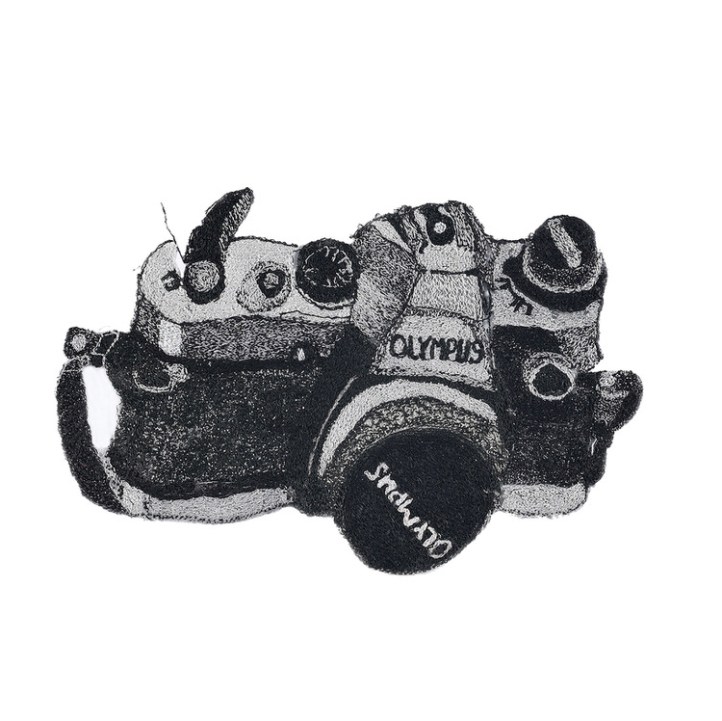
…I was told by a tutor that I should not using drawing for my practice…I would and did find a way to make drawing work
2. How do you balance traditional techniques with contemporary influences in your work?
Embroidery – the art of decorating cloth and often associated with years of practise to perfect a flawless design. A person who is doing embroidery is usually called an embroiderer. And I have fitted in with this label applying to open calls for artists who use embroidery to create and having work published in journals whose specialism is embroidery. But I have fallen into this categorisation – I haven’t been taught how to stitch and didn’t set out to be an embroiderer; I explored it when trying to find a way to share my critical conversation. The process allowed me to explore how I was living in the wake of suicide loss. And now, I am passionate about championing a feminine artform not always considered worthy of fine art – take for example The National Portrait Gallery whose annual Portrait Prize does allow textile art entries!
3. What role does materiality play in your art, and how do you choose your materials?
The key role of my artwork is to share my conversation, one that can be hard to express in words but critical to being shared with those who can listen. With the difficult subject, loss through suicide, a beautiful soft feminine material made with a common domestic machine can be a perfect vehicle for delivering a raw and much needed conversation.
However, there is an added layer of complexity to my material choice – that of jeopardy. I was scared of drawing and inhibited by preconceived ideas of what it should be, but it was fundamental to my practice. I was also scared of living in the wake of loss through suicide being terrified that something else catastrophic would happen. The materiality of thread allowed me to explore this in the safety of my own space, a fact that is crucial to when trying to speak words that can be hard to say. Stitching obsessively for hundreds of hours, I can manipulate every stitch that I make to produce a photo-realistic embroidered drawing. And at the end of making, the supporting water-soluble fabric is removed, and all control is lost, the stitches are released and any errors of making can be seen. The parallel with living, profound. And as I endeavour to accept the changes that have happened in the making, a critical process of understanding is delivered by the materiality of the artwork.
…there is an added layer of complexity to my material choice – that of jeopardy… at the end of making, the supporting water-soluble fabric is removed, and all control is lost, the stitches are released and any errors of making can be seen.
4. Which piece of your own work is your favourite and why?
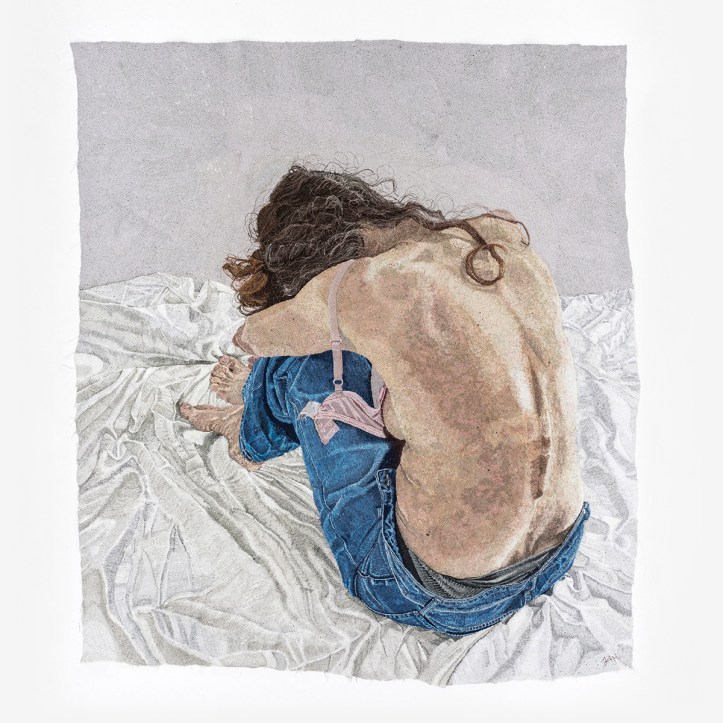
It is difficult to choose my favourite piece of artwork because each one is made with a burning need to talk about the most pressing, complicated issue that my grieving process is embroiled in at the time of making. Grief is not a linear process defined by any period – it is fluid, unpredictable and likely to raise its head at any inopportune moment. With that aside, and the fact that I must choose, my favourite artwork is my most recent, It Had to Be So, made in 2024. The reason for choosing this piece, its intimacy, its scale and my ability to successfully use two years of valuable research gleaned at the Royal College of Art where I had studied an MA in Textiles. The work was revelational – it was the first time I had really allowed myself to open up and say how it really is – how the body keeps the score – and how talking about it is critical. Suicide is still the biggest killer of men under the age of 50 and mental health services abhorrently funded.
5. Do you have a favourite artist who inspires you?
I have a few artists that inspire me – some write, some paint and some stitch but perhaps the greatest influence is Tracey Emin, whose raw, deeply autobiographical and intimately confessional art has put her front and centre of my research folder for many years. Her strength and commitment to say how things really are and to hope that by doing so, she can help others.
Over one difficult Christmas, I watched nearly every YouTube video that I could find in which Tracey Emin spoke about the power of art and how it helped her to survive. The words resonated with me, they empowered my practice but perhaps most importantly, she made it ok to keep my grief at the front and centre stage of my making if that was what I needed to do.
I have recently seen Tracey Emin live at the How to Academy, London. To say I was excited was an understatement – my hero on the stage, five rows in front of where I was witting. I followed this up with two visits to her major retrospective, currently on at Tate Britain.
Inspired by the fact that Emin creates art with no emotional filter, I have been encouraged to share my story as it really is.
Inspired by the fact that Emin creates art with no emotional filter, I have been encouraged to share my story as it really is.
6. What’s the most unusual thing that ever inspired a piece you made?
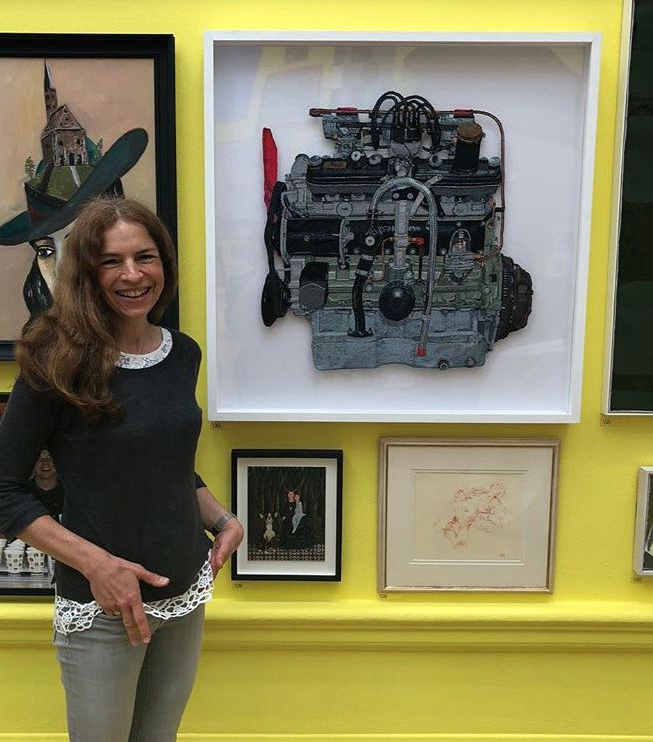
Well, this one is easy – putting oil into my car engine. The action triggered an idea for my first large, free machine embroidered drawing – The Bristol 2 Litre Engine, 2014.
My love of stitch to create my artwork started during my BA at Bath Spa University which I commenced one year after Carl died. The stitched drawings focused on the new role I had unwittingly taken on – that of both mother and father to my two young sons. The new role also meant taking on jobs that had once belonged to Carl – car maintenance being one of them.
Before starting this project, I had only made small pieces of stitched work, images of his tools – a hammer, a drill and some delicate screwdrivers. This drawing would be my largest one to date and the most important – it was to be my graduate show piece. With over 350 hours to make, and advice sought from an overseas artist on how to remove the water-soluble backing from a large free machine embroidered drawing, the finished piece washed and dried successfully, won best in graduate show and was selected for the RA Summer Exhibition in 2018 where it sold to a private buyer.
7. Do you start with a concept, or just let the work unfold as you go?
Concept is key – my artwork is always about what I have to say. Whilst the research may start with the smallest and simplest of ideas to understand what approach is necessary, it is the nailing of the question that is fundamental to my belief in the success of the making, and with that, I can commit to the hundreds of hours of making that are required to make the project a reality.
8. What has been your darkest (textile) teacher – aka the troublesome project or process that has taught you the most?
This is quite a tricky question to pinpoint and perhaps the answer is an ongoing one. Every time I start a project, I always have a preconceived idea about how easy or difficult it might be and what part of the drawing may be the stumbling point. When I started drawing A Couple on the Tube, it was the first time that I had attempted to draw people –compelled to give it a go after the critical advice received on my BA.
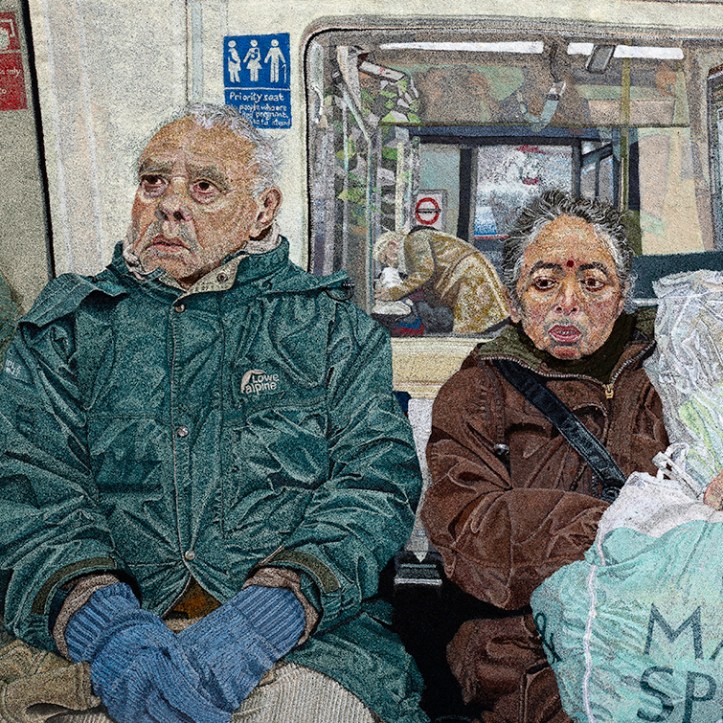
I started cautiously with the eyes assuming that this would be the most difficult part? The correct gaze is essential to capture the essence of the person and the story being told. The first attempt failed, but the second was successful and so I was off, but the difficulties did not stop there. Whilst I had assumed that anything was possible if I could draw the face and get the essence of the person, correct, trying to reproduce hands, translucent materials, corduroy fabric, glass, and old leather, provided issue after issue with each element of the drawing potentially making me fear the possibility of completion. But fortunately, lots of testing and removal of mistakes enabled me to slowly finish the drawing.
However, the learning continued, this would not be the only time that I would mistakenly assume how easy or difficult a work could be. My next huge stumbling point happened in It Had to Be So. Again, I wrongly assumed that it would be a more manageable draw – there were no facial features, no unusual materials – only the clear expanse of my back, but how wrong I was. With no ability to draw in the landmarks and work across the body whilst referring to marks and tones already laid, as is normal for life drawing, caused two lengthy attempts to fail as I tried to draw my back through a 20cm hooped window. However, not one to give in, I endeavoured to continue. Trialling new flesh coloured test samples of varying tones I made a detailed colourway plan across the back (marked out on the water-soluble fabric), and finally made it work.
So, the answer to the question – I still haven’t learnt and still get caught out by my preconceived ideas of what may and may not work. However, I have learnt that by not giving up, anything is possible!
I have learnt that by not giving up, anything is possible!
9. Do you think academic qualifications for creative practices are helpful or a hindrance? Is it the qualification that’s useful, the time and practice you put into it, or would you get the same benefit if you did that on your own?
This one is easy – I strongly believe that the academic process that I have been through has been vital to my creative success. I have a BA from Bath Spa University and an MA from the Royal College of Art. Whilst the qualifications have not been a statutory pre-requisite for the work I make, the open calls I have entered and creative opportunities that have come my way – giving talks and running workshops, there is no doubt that the critical engagement and challenging research projects provided by my tutors and the academic organisations criteria have helped me form the backbone of my practice. Without the BA tutor telling me to rethink my drawing practice and the RCA tutors facilitating a challenging platform that allowed an open engagement of difficult subject issues, I know that I wouldn’t have the confidence and critical enquiry essential to create my award-winning, grief focused, drawn artwork that talks confidently about living in the wake of suicide loss.
10. What is it about the way your brain/body works that leans you towards textiles?
Textiles are familiar, it is a medium that I grew up with and one that I have always turned to in times of need. I will knit when I must find a way to relax, I will stitch when a garment is required for a special occasion or I have some lonely hours to fill. And because it is a familiar material, I can use it confidently to question and explore complex issues that could otherwise be difficult to share. Also, textile art is empowering. It is a soft, feminine material associated with beauty and domesticity. I believe that this provides accessibility through familiarity, and a softness that can warm and nurture an uncompromisingly difficult subject, that may not be possible with the more traditionally associated fine art mediums.
…because it [textiles] is a familiar material, I can use it confidently to question and explore complex issues that could otherwise be difficult to share.
Julie Heaton

