
Lou Baker makes public things that are normally private, provoking a range of conflicting responses. Shapeshifting, her work is immersive, alluring, yet somehow, also, uncanny. It’s as if she knits together people and places with material, process and concept, stimulating thought, conversation and action through sculpture, performance and social engagement.
www.loubakerartist.co.uk
@loubakerartist
Artist Statement for Warped and Wasted
‘Care is fundamental to my Warped and Wasted learning; proactive care for the environment and interconnectedness, but also the collective care of team seam – in challenging ourselves, in our thought-provoking conversations and careful planning but also the mutual support. Unravelling the complexities of the issues surrounding textiles, sustainability and collaboration together, communication and compromise have been key. Then there’s the care I’ve taken in making new work, in the stashed materials and slow processes I’ve chosen. I see the Warped and Wasted installation not as the end of my learning or seam’s collaborative journey of sustainability; it’s a beginning.’
Details of individual works
Tying up some loose ends, 2025
Materials: 100% Peruvian Highland wool – Cascade 220, manufactured in Seattle, USA – shipped to UK Wholesalers
I love knitting with pure wool and I love working with colour. I began using one particular brand of wool, Cascade 220, when I started making knitted sculptures about 15 years ago. It comes in the most astonishing range of colours, it’s relatively inexpensive and it felts well in a washing machine. To begin with, I could also buy it in my local yarn shop in Bristol, where I live.
So, I very happily used it almost exclusively for my knitted work until I joined seam in 2022. Then I began to seriously question the fact that I was buying Peruvian wool which was manufactured in the US and then shipped to the UK. My local yarn shop also, sadly, closed, so then I had to order it from a UK wholesaler far from where I lived. I also began to realise that the dyes used to make such vibrant colours are probably not great for the environment. I still have a large stash of it, which I will use up, but since then I’ve been making sculptures with a large stash of mixed yarns that has been given to me. The stash belonged to someone else’s mother – a mix of natural and synthetic yarns. It’s been really interesting for me to work with very different colours and textures and I think has added greatly to the work I’ve made since then. (See below for some new works made with this stash.)
Anyway, over the past 15 years or so, while I used Cascade 220, I saved all the loose ends I cut off my knitting. Is that an odd thing to do? I obviously saw those strands as potential then and Warped and Wasted has made me do something with them, finally. So, over the last few months, I’ve been unravelling the big bag of tangled threads, tying them together to make ‘new’ balls of yarn and then knitting a new sculpture.

Here are some more details of the ideas and processes on Instagram – and lots more photos of the work in progress!
Invisible, 2024-25
Materials: White, beige and cream mix of vintage natural and synthetic yarns from someone else’s mother’s stash, origin and composition of fibres unknown, found netting
Here’s a small and random sample of where the yarns have been made, but there’s no indication about the provenance of the raw materials:
3 x Darlington, UK (mohair/ wool/nylon and wool/acrylic and mohair/acrylic)
2 x Wakefield, UK (100% wool)
Copenhagen, Denmark (100 % cotton)
Hungary (100% cotton for Rowan)
Peru (Alpaca)
Sweden (100% cotton)
Many of the yarns no longer have labels. A lot of this yarn might date back to the 40s, 50s or 60s and more yarn was made in the UK then, but now it’s often made elsewhere in the world.
The netting came from Scrapstore.

Tangled webs, 2025
Materials: White, beige and cream mix of vintage natural and synthetic yarns from someone else’s mother’s stash, origin and composition of fibres unknown (information bands missing – see above)
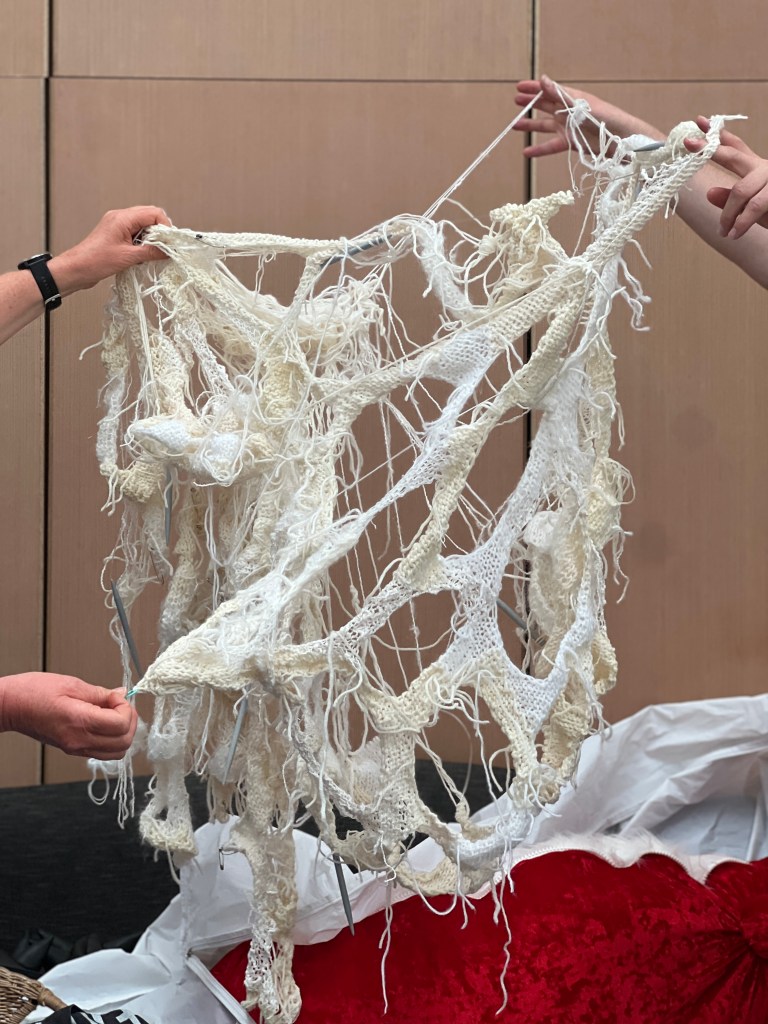
to the rest of the seam members at Collaboration meeting 4
Learning so far, August 2025
The most significant learning for me during the Warped and Wasted project for me so far has been about finding more authentic ways to care for the environment through my art practice, but also about how important it has been to work with others and to care for and support one another as we learn together.
Being an artists can be quite solitary, so working with others is important to me, but working collaboratively is different. It’s much harder. It involves making sure that communication is effective and there’s inevitably lots of compromise – but it’s worth it! It’s so much better to have others with whom to discuss these huge dilemmas, to share the work, and the highs and lows. I’m very grateful to the rest of team seam and to our mentors, Judith and Helen, for the in-depth critical thinking, mutual support and collective ambition to make a difference in terms of textiles, sustainability and collaboration through Warped and Wasted. I feel very proud of what we have achieved – the ways that it has encouraged myself and all the group to challenge ourselves about making work differently, our plans for eccentric curation, the dream of the day of Textile Talks becoming a reality – all underpinned by the more theoretical discussions we’ve had about seam‘s sustainability and collaboration. Go team seam! To find out more about all this detail, please visit Warped and Wasted.
For me though, it’s definitely a beginning, not an ending.
One of my ongoing dilemmas about being an artist in relation to the issues surrounding textile waste and the environment is wondering whether I should stop making physical art works altogether, as their future disposal becomes part of the problem. Could I focus instead on performance? Or digital art? But I’m an inveterate maker, reluctant to perform, and I gather that anything involving electricity, tech and screens is also potentially problematic for the environment.
Another question I ask myself is whether a small group of artists can possibly make a difference to such an enormous and overwhelming situation? In answer to this, I have to remind myself of the history of activism…that the relatively small acts of individuals can make a difference and can bring change.
So, in terms of making new work for Warped and Wasted, I had to make some decisions. Inevitably, maybe, as a maker, my next thought was to consider making work with fully biodegradable materials. Wool is an obvious choice, but using local fleece, like some of the other seam members chose to do, wasn’t an option for me as I’m allergic to it in its raw state. Is it the lanolin? I’m not sure, but I couldn’t work with it in the volume I’d need. I’ve also researched other compostable materials, like mycelium, bioplastics and algae yarn, but quickly realised that I will need more time to learn how to make sculptures with such different materials. I plan to do more reserach with these materials after this project.
However, as well as being a maker, I’m also a collector and I have a substantial stash of treasured materials. Some of it I’ve gathered over many years as potential for making, some of it I’ve been given or inherited – other people’s large stashes of yarn, used clothing and bedding etc. Through discussions with the other seam members during our in-person Collaboration days and other online meetings, I realised that I could allow myself to keep using my stash. It already exists, and repurposing it as art extends its life and delays its disposal. It’s a beginning.
Since joining seam in 2022, I have been challenging myself about how to be more sustainable in my practice. For our A Visible THREAD exhibition tour, I exclusively used materials from my stash. See the two blog posts I wrote for seam then Busting someone else’s stash and Stash busting and shapeshifting.
So, for Warped and Wasted, I have been researching and developing a number of ideas. Some I have pursued, others I hope to return to in the future. Some of these works will feature in the Warped and Wasted installation and will have yet another life afterwards, being shown in other settings with different audiences. But it’s just a beginning…
 seam
seam 