With functionality at the heart of her practice, Angie Parker is led by colour and structure in her woven pieces. She is also the author of the book, Krokbragd: Contemporary Weaving with Colour. Based in Bristol, she has been addicted to weaving for over 30 years.
www.angieparkertextiles.com
@angieparkertextiles
Artist Statement for Warped and Wasted
‘I am submitting three handwoven panels using a selection of waste and reusable materials. One of these is on a much larger scale than anything I have created before. I am re-evaluating the relationship I have with my extensive yarn stash and the energy I create whilst weaving. I have relished the opportunity to use the different materials experimentally whilst honouring my personal commitment to create functional work. One concern during production of the work is what will happen after the exhibition. The plan is to dismantle the installations to produce a series of rugs. These will have clear instructions about how they will be disposed of when they are no longer fit for purpose. I, the maker, will be ultimately responsible for ensuring the work is disposed of responsibly.’
Details of individual works
A mobile phone charger?, 2025
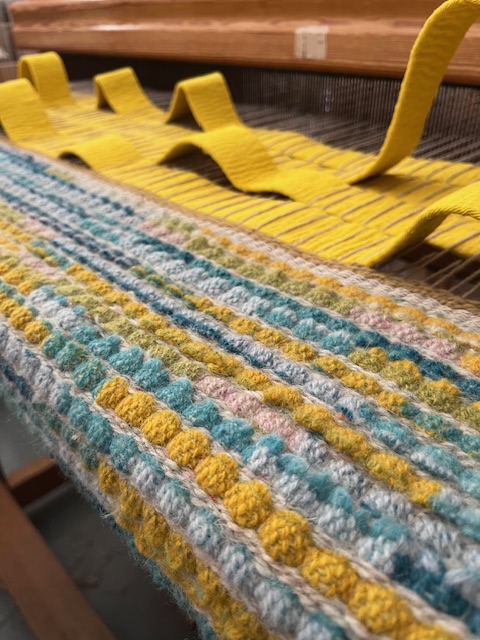
Materials: Warp: Linen Weft: Rug Wool, natural wool, lambswool selvedges, karate belts -(cotton), acrylic knitting wool
Dimensions: 85cm x 545cm
Weaving is a slow process. Whilst an allocation of five days is an absolutely dream in a project like Warped and Wasted, I knew I had to adapt my usual way of working to create my work for the project.
I simplified my process to use only plain weave and combined multiple strands of yarn to create an extra thick weft. Up to 16 or 20 strands at a time. This was a great way to weave large lengths efficiently and use up lots of my yarn stash to create a functional floorcovering.
I ran out of time to finish the loose ends in the way I normally would and instead left them hanging on the reverse of the weaving. This made the surface more visually interesting. When the artwork is dismantled at the end of the exhibition, I will separate each rug and stitch the loose ends in to make the surface smooth and the rug durable.
The Karate belts will be removed from the artwork to create future artworks or to return to being Karate belts. Lou Baker’s sculptures will also be removed and returned to Lou for future exhibitions.
Mottle the sheep rug, 2025
Materials: Warp: Linen Weft: Wool and raw fleece courtesy of Mottle the Sheep from the city farm across the road, acrylic wool
Dimensions: Approx 75cm x 170cm
Mottle the sheep rug was created through a similar process apart from carding the fleece. This time-consuming element was carried out during the online meeting for the exhibition planning. There was lots of the fleece left over so I will be creating more of these rugs in the near future to sell though my practice and use in our home.
The most unexpected element of being part of Warped and Wasted is the impact it’s having on the shape of my practice. When I invested in the 2 tonnes of rug wool from the Peter and Jason Collingwood workshop acquisition, I didn’t know exactly how it would fit in with my business. The time and space to create brand new work for Warped and Wasted has illuminated the path for me to follow and I will be launching a new sustainable rug collection and a new sustainable rug weaving workshop in the coming months.
Learning so far, August 2025
The ideas, conversations, thoughts and processes around producing the work for Warped and Wasted have been as significant as the work itself.
Initially I hoped to carry out research into harnessing the energy I created through the movement of beating the weft on the heavy rug loom, but soon realised that I would not have enough time to do this as well as create enough work to fill the vast gallery space as we intended. Instead, I chose a weaving sett that makes it easy to calculate how many times I beat the weft to produce each rug so that I might be able to estimate how much energy I create. The idea to use my studio to harness energy is something that I will look into in the future and I hope to connect with technology students soon.
My initial plan to use the materials from my stash that don’t align with my typical brand colour palette was a good starting point, and this developed organically to use the waste selvedges from my mill woven blankets and the karate belts that fellow seam collective member, Nina Gronw-Lewis sourced. A conversation with other seam members ignited the flame to approach the farm across the road from the studio and I luckily was just in time to secure a shearling fleece from ‘Mottle the Sheep’.
I planned to blend the fleece with 100% wool and linen in the hope that once this rug is no longer fit for purpose it can be safely composted at the farm.
I also acquired some of Lou Baker’s sculptures to weave into the filler sections between the rugs. This alongside the karate belts was a space for play and experimentation. Via an informal WhatsApp creative critique group I was encouraged by seam members to be more adventurous and playful, and this has planted a seed to create more work like this going forward.
The decision to create large woven panels was brought about in response to the gallery visit when the scale of the project became apparent. I was also mindful that a number of seam collective feel more comfortable creating smaller scale work so I felt it important to push myself to create on a larger scale than normal to respect our different styles. The colour choices were also in response to the conversations in the meetings. Yellow was the common theme but I hope to keep my palette quite calm in comparison to my usual work. This will hopefully allow for quiet spaces in the installation.
 seam
seam 