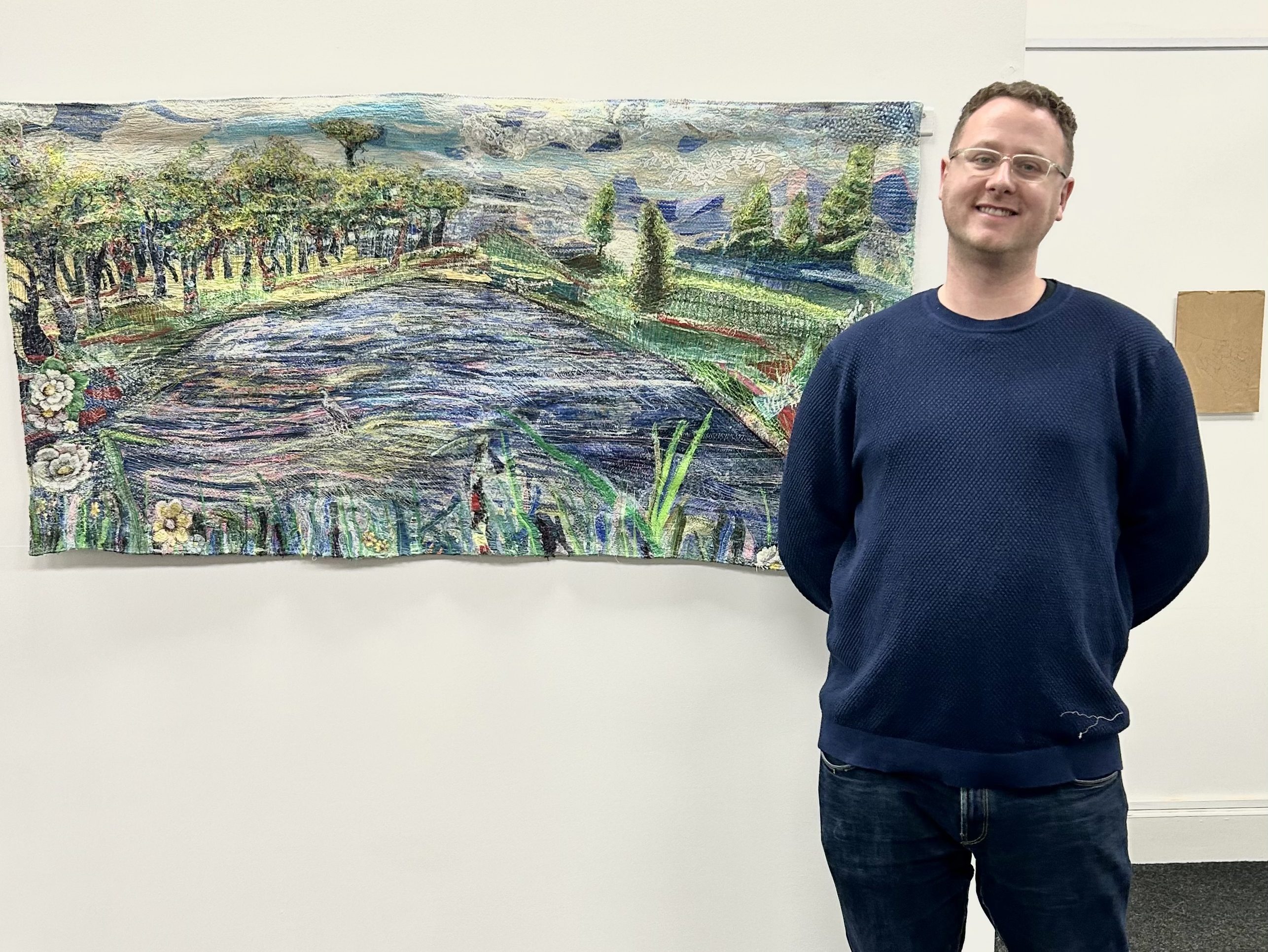
Since November, I’ve been sneaking away one day a week for a deliciously nerdy textile pilgrimage: a six-month-long residency at Gloucestershire College, organised through the coordinated efforts of Artists Access to Art Colleges (AA2A).
And it’s been glorious. Being in an environment buzzing with textile energy has felt like plugging myself into a creative power socket.
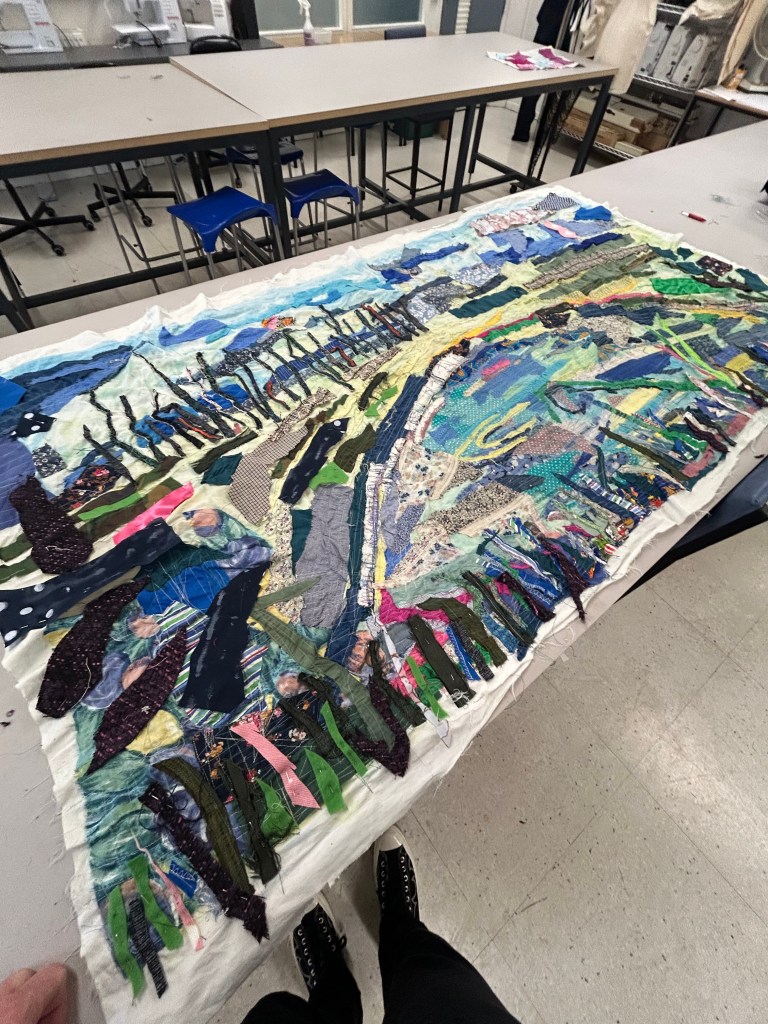
The day I met the industrial sewing machine (AKA my new frenemy)
One of the biggest joys of this residency has been gaining access to the industrial sewing machine at the Cheltenham campus.
Let me tell you — this thing is an animal.
Using the industrial machine has felt like pressing fast-forward on myself. The horsepower! The speed! The way it chomps through fabric like a starving person inhaling noodles! The clatter of the mechanism sounds like a Gatling gun firing out a perfectly tidy running stitch.
But with great power comes… snapped threads. So many snapped threads.
Because, as I learned pretty quickly, just because I want to go fast doesn’t mean the machine does.
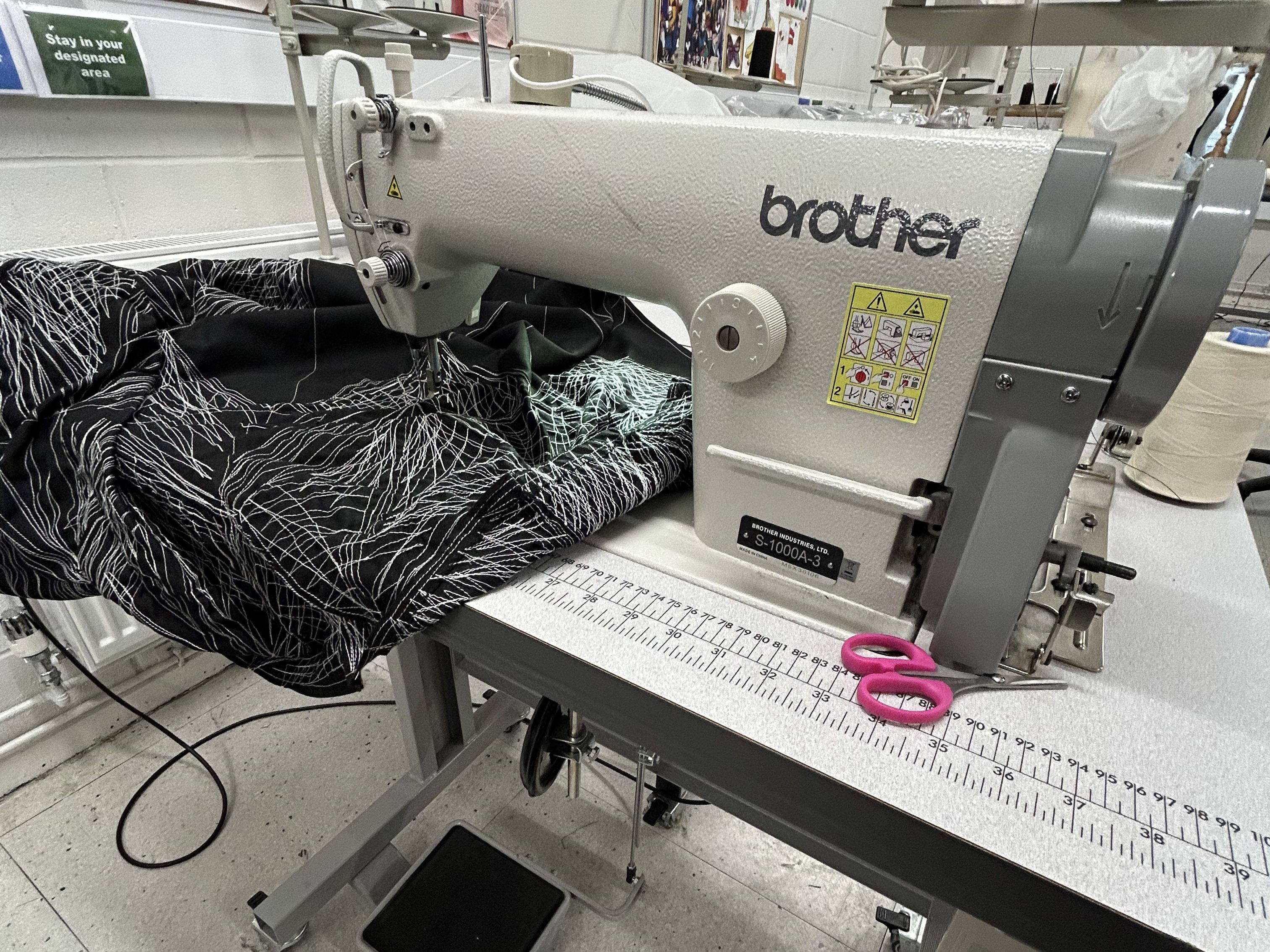
The whole experience reminded me of my mum trying out a sports car for the first time — one tiny press of the pedal, and suddenly we were launching toward the supermarket like it was the starting line at Silverstone. My mum screaming, the engine roaring, and absolutely no one having a good time. Useful for shopping for three kids? Not so much, it was a shortly lived experience replaced by something more practical.
But this speed is exactly why I wanted the residency. Before investing in a heavy-duty machine, I wanted to learn the ropes so the fabric didn’t feel like it was slipping through my fingers like running water from a tap.
Enter Janina, the industrial machine whisperer
I was nervous setting up these big machines. One incorrectly placed thread and suddenly the whole thing sounds like it’s trying to escape the table. Janina Bacchetta has been very supportive whilst I’ve been doing my residency. She helped steer me through the correct set up (it is wild how much you can impact on the sewing if not done correctly!). We’ve had several conversations together, and she has been a rich source of knowledge alongside the rest of the team at the college. I did a fine-art painting degree instead of a textile degree and this time has been helpful in introducing me to different processes I’d not had a chance to take part in. Janina has introduced me to foundational textile processes that I would not have come across and in exchange I have been talking through my stages of building up my work.
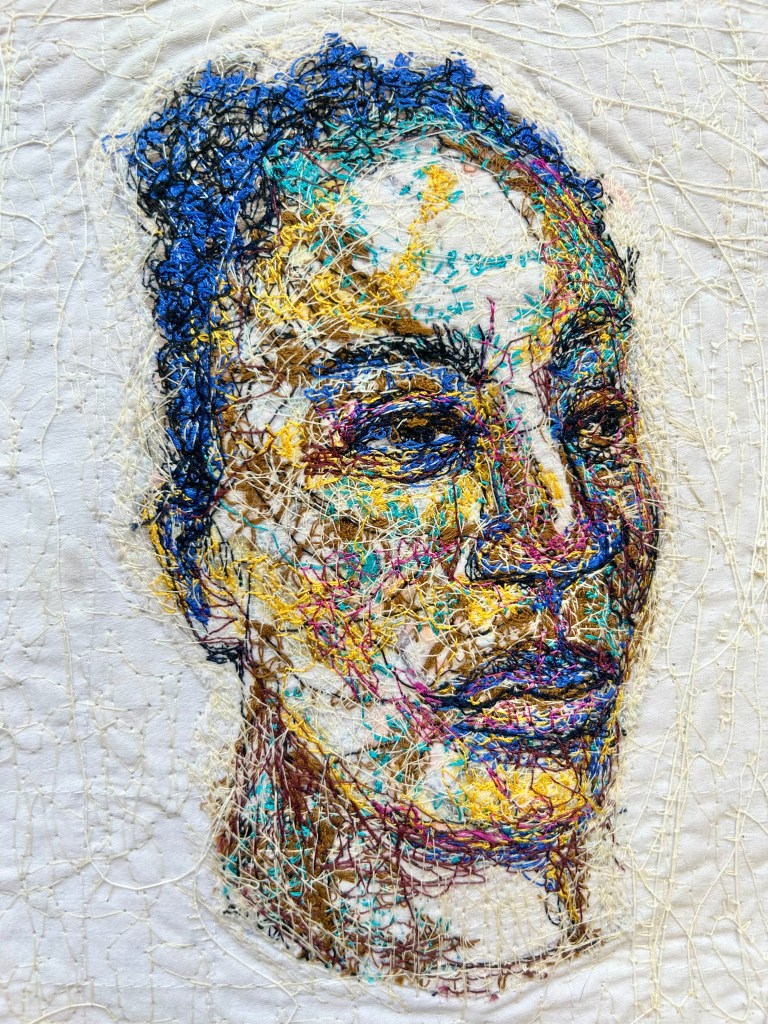
In fact, it was through these chats that we both ended up taking part in ACEarts’ exhibition Still Lives. I quickly thought her work fit the show’s theme and passed her details on to the curator and fellow seam member, Nina Gronw Lewis.
Spotlight on Janina’s work
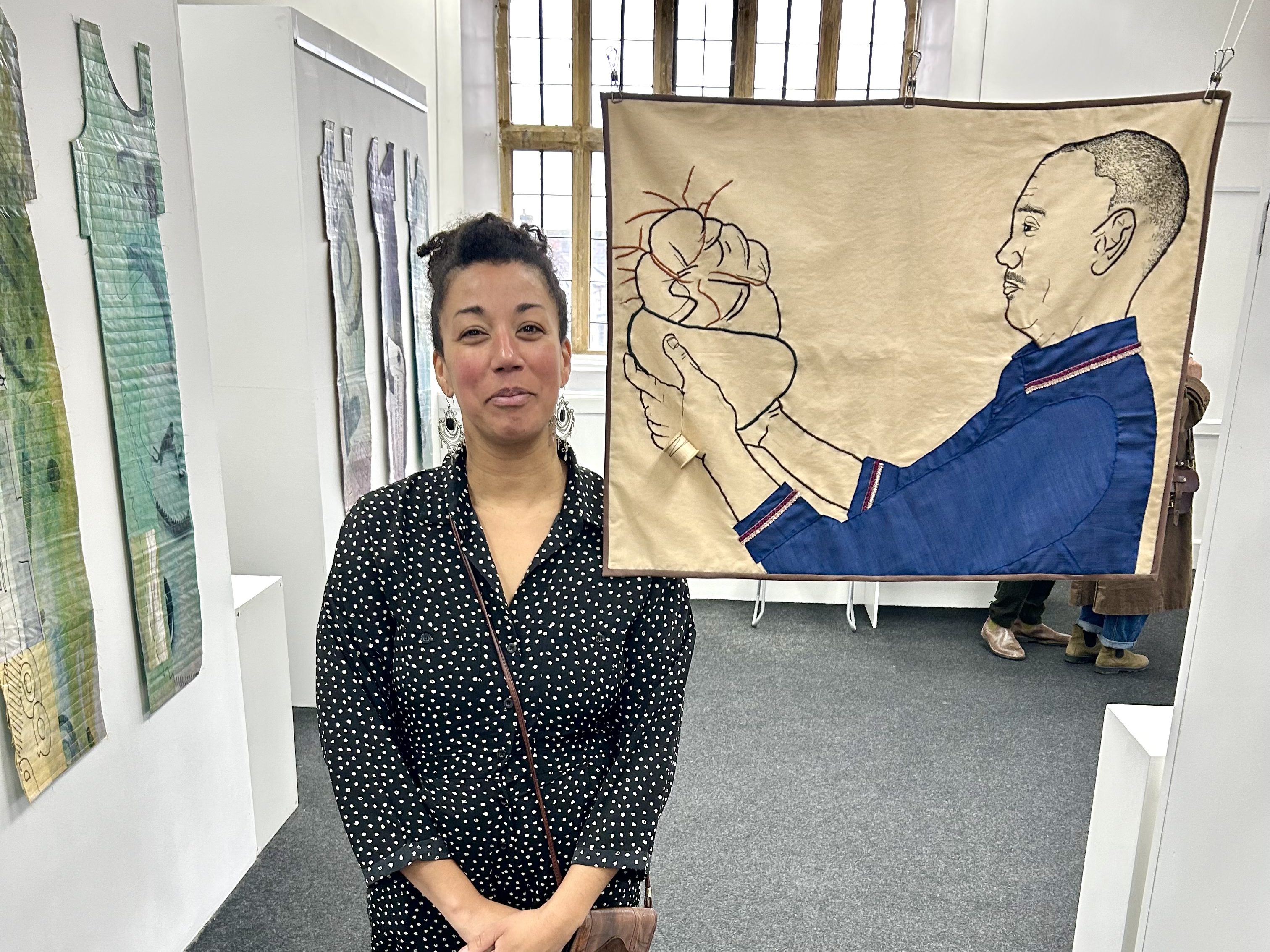
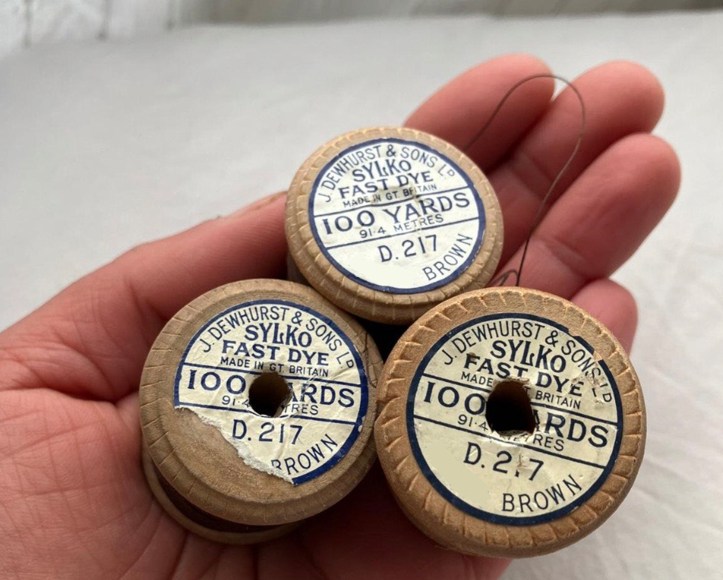
Textile artist Janina’s textile portraits are breath-taking — meticulous, character-rich, and almost unbelievably consistent. With her background in textile and wig making, she has a way of stitching that looks machine-perfect but is hand-crafted. She works with vintage Sylko threads that carry harmful historic language in their colour names. By incorporating these threads into her portraits, Janina reclaims and reframes this difficult heritage. Her work honours contemporary inspirational figures from Black and Brown communities, transforming a past rooted in exclusion into artwork that champions representation and sparks critical reflection.
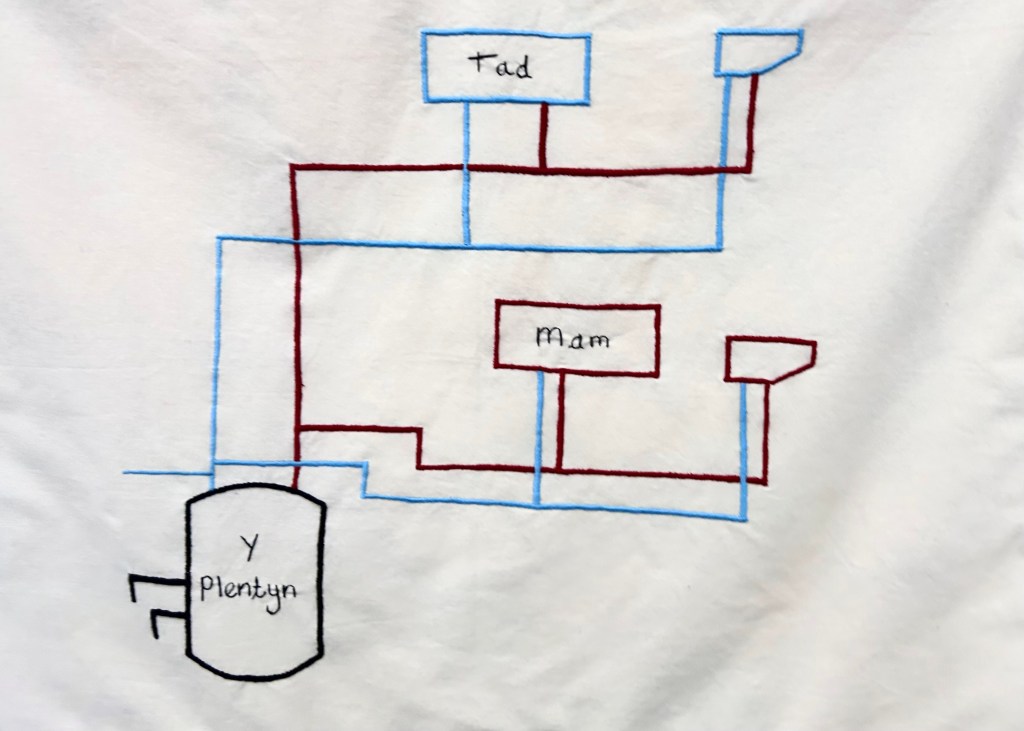
One of the standout pieces she created is a double-sided portrait of contemporary glassmaker Christopher Day. She stitched in coloured pipelines to represent both his plumbing past and the copper cage forms present in his glasswork. The red and blue lines woven through the piece reference his mother and father, labelled in Welsh (linking her own family and identity, with his), anchoring the work in identity, heritage, and home.
‘…funny enough. I was actually thinking of Chris’s family tree which we talked about on the phone, But I didn’t want the reference to be, 1) too obvious labelling it Chris, Mother, Father or 2) Child, Mother, Father in English. That’s when I thought about writing it in Welsh, so that it wasn’t so obvious and to reclaim the Welsh language, which is fighting to reclaim its identity as Chris and I both have.‘
@janina.bacchetta
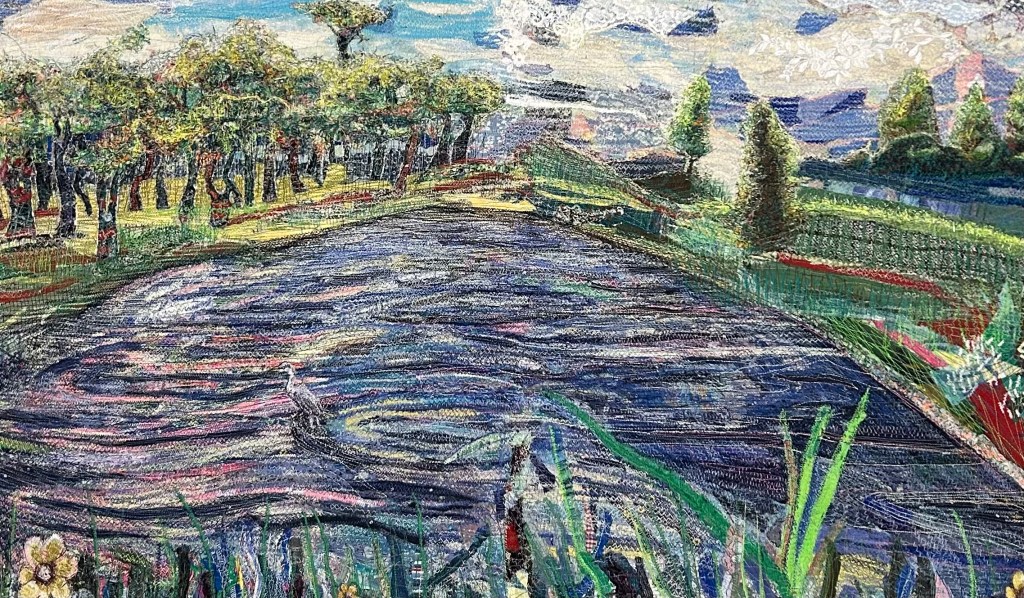
My piece for Still Lives: When the Heron Calls
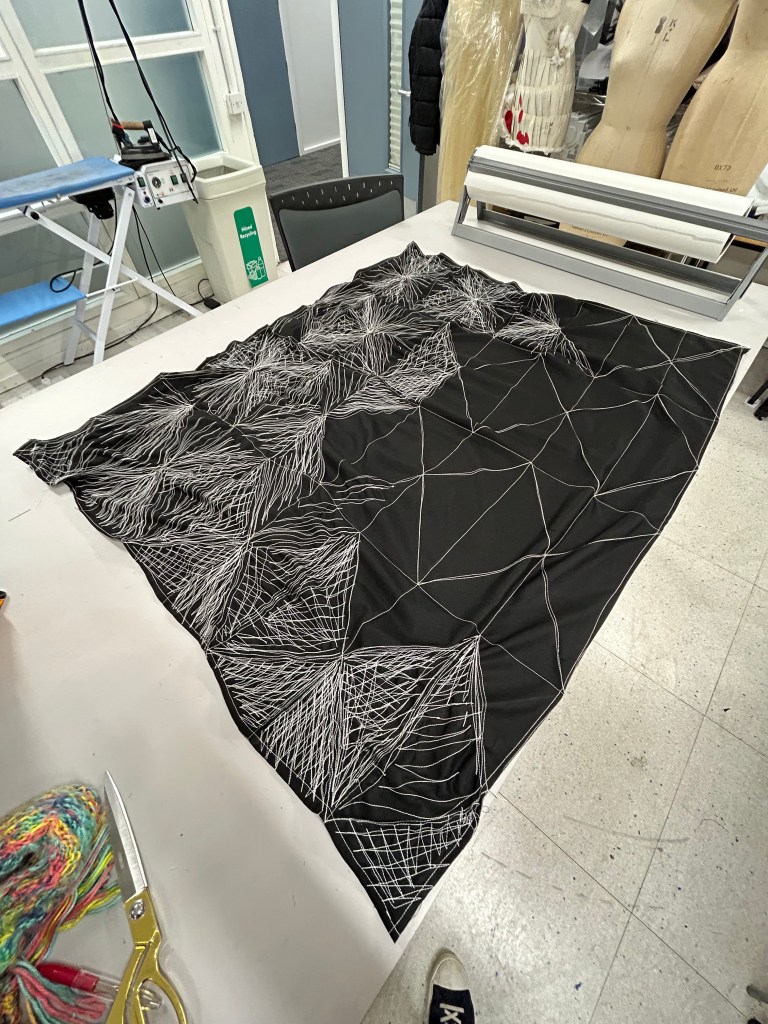
My own contribution to Still Lives was created during the residency. When the Heron Calls draws on times spent wandering Bodenham Arboretum, Powick Old Bridge near Laughern Brook, and the River Teme in Worcestershire.
The piece grew from a quiet moment with a heron — a shared instant of watchfulness, patience, and solitude. I wanted to capture that hush, that sense of solitary pursuit.
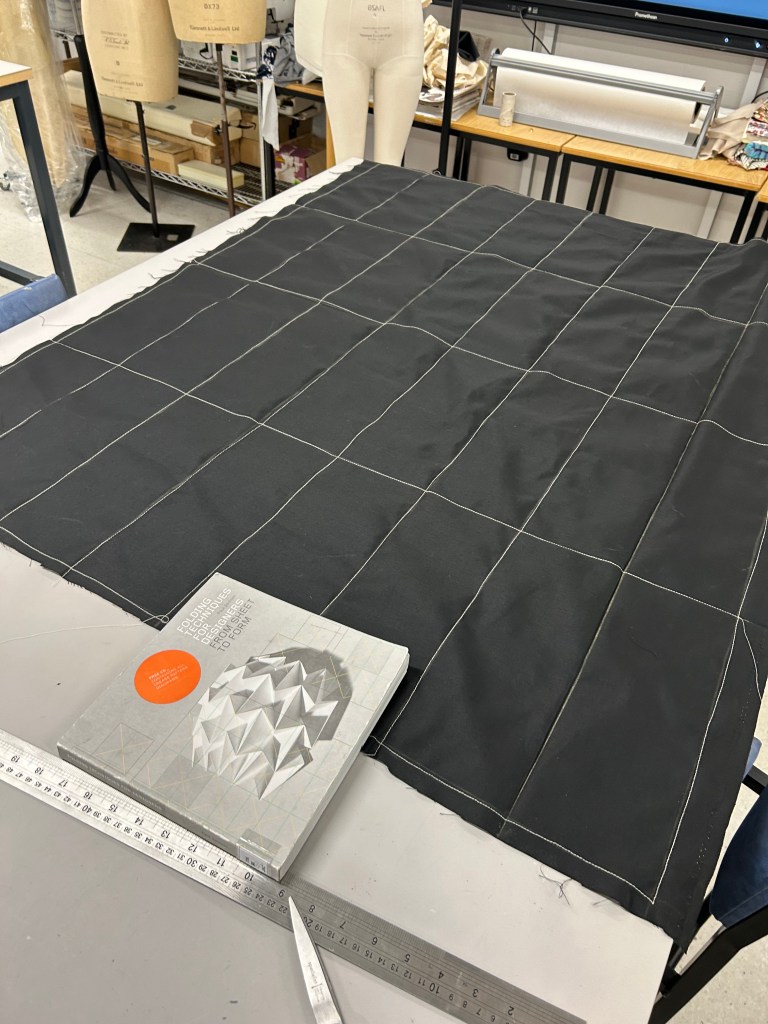
I worked onto one of my parents’ old bed sheets and used the industrial machine to map out a grid —something that would normally take me 25-30 days. This time? Thirteen days. Thirteen! The machine doesn’t do everything (it only runs a straight stitch, so my domestic machine still saw plenty of action), but it took the heavy labour out of the structural layer.
Working at this scale remains deeply intuitive for me — fluid, responsive, immersive. Threads layering, tangling, building weight and volume.
The joy of experimentation (and a very good library)
Another perk of the residency? The college libraries. An excellent anime collection (which has revolutionised my train journeys home), and a treasure trove of craft, design, and art books.
An influential discovery has been Folding Techniques for Designers by Paul Jackson (2011). The cover alone had me buzzing — the structural, sculptural potential! It’s feeding directly into ideas I’ve been considering since working with Lou Baker on Glowing and Growing: an installation using second-hand materials and threads.
When I shared this direction with the seam collective, several members suggested exploring Canadian smocking… and I’m now happily tumbling down that rabbit hole, experimenting, folding, stitching, seeing where the process wants to take me.
There is still time to catch Still Lives, an exhibition of embroidered intimacies from around the world. The exhibition features: Janina Bacchetta, Oliver Bliss, Alice Bowen Churchill, Jane Colquhoun, Gary Dickins, Nina Gronw-Lewis, Sandra Meech, Joy Merron and Lydia Needle. Still Lives presents embroidered works by artists who transform everyday domestic moments into quiet reflections. Through thread, scenes of home and habit are paused and made extraordinary — a gesture, a glance, a shared moment.
The exhibition features intricately hand-stitched works created by women artisans in Karachi, Pakistan, on loan from Alice Kettle, and invites us to slow down, notice the beauty in the ordinary, and find connection in the rhythms of daily life.
Still Lives:
24 January-28 February 2026
ACEarts, Market Place, Somerton, Somerset, TA11 7NB
Tuesday 11am-5pm, Wednesday-Saturday 10am-5pm
If you would like to see how the residency progresses, follow me on Instagram @olybliss and also check out my website www.olybliss.com to see more of my work.
Oliver Bliss
Edited with Co-Pilot
 seam
seam 