The Warped and Wasted exhibition is installed at ACEarts and opened on Saturday 23 August – many, many thanks to our intrepid curators: Lou Baker, Nina Gronw-Lewis, Joy Merron, and Nicola Turner, supported by Oly Bliss and Lydia Needle who created an amazing, immersing transformation of the space.
Come and see for yourselves! Join the conversation about textiles and sustainability, meet the artists and curators on Saturday 30 August from 11am-1pm and find out more by booking tickets for our symposium Textile talks: Textiles, sustainability and collaboration on Friday October 3.

The artists’ rules
We wanted Warped and Wasted to be a collaborative exhibition but our different schedules, disciplines and locations across the Southwest make it impossible for us to make and share our work except when we met together for our collaboration meetings.
Instead we agreed on a set of rules for all the artists to work to:
- Work with waste, existing second hand materials or items from your stash. Artists were able to swap stash and waste items between themselves.
- And/or work with sustainable materials, which could be bought new.
- Incorporate some yellow in our work (inspired by a gift to Nina of 50 well-made yellow Karate belts).
- Be inspired by our research and work with our mentors, Judith can den Boom and Helen Carnac on sustainability.
We also created a WhatsApp group solely to continue sharing our work in progress after the in-person meetings concluded, which kept momentum going and was so inspirational for the artists – but also gave the curators sneak previews of the work. Critical reviews were arranged with other members on an as-needed basis.
The curators’ rules
We started to think about the curation, together, early in our collaboration meetings, but we got stuck, finding it difficult to articulate/visualize how it would all come together.
We found a way forward by delegating the curation to a small team, Lou, Nina, Joy and Nicola, who started planning immediately. They held six planning meetings online, two with mentor Judith van den Boom, and conversed over a few email chains.
Preplanning was essential as we worked through many iterations of how it could work.
Joy Merron
The inspiration for the curation became the image below of laundry hanging from windows on bamboo sticks in a street in Shanghai.


It was useful having an external eye.
Nicola Turner
With Judith’s guidance the curation team developed the following set of curation rules:
Ground Rules
- Base line support materials that connect and hold the work: neon yellow tape x karate belts x guyropes x tentpoles x yarn
- Attitude is no-nonsense, meaning not over-designing but using ropes/belts/tapes in ways they show what they do.
- Work with a straightforward, practical, and efficient approach to things, edit out unnecessary fuss or complexity
- Nothing is disguised: If it’s a rope, it’s tied like a rope etc.
- Warped is part of the work.
- The imperfection and tension are part of the aesthetic. Let the work twist or pull if they naturally do.
Setup
- Let the support systems be visible and improvised.
- Every work is linked by neon line, the line is the seam, the thread, the logic
- No work on the walls, only for suspension
- The floor is used – work can touch, stand, be suspended from the floor.
- Tent poles as horizontal suspension, they are structural and expressive, they don’t need to be level or symmetrical
- Tent poles not at the same height – they are meant to bend, so show it off.
- Use tension between poles and textiles to create zones, shifts in height, and interruptions.
- The finish should not be per work but how the whole comes together
- When using lighting this should help see how things are made, not dramatize them.
- If something breaks, fix it visibly, let the fix be part of the show’s evolution
- Don’t overload the space, give space for people to step back
Communication
- No names per work, it’s a seam show, not an individual one
- Sticky-note question wall should not be hidden away – make it a feature
- Print questions and main subthemes in a large simple font (no over-design)
- Book informs the work, photograph the final and print/stitch
- Print text ‘general statement’
- Feel the space – how does the audience walk around?
- What does the space communicate, is everything clear ?
The team developed some hanging rules which were useful for clarifying the vision, dividing up tasks, and making sure everyone felt heard in the process.
Oliver Bliss
Installation
The curators read the ‘rules’ at the start of each install day and tried to keep them in mind as they worked in the space.
The ‘rules’ enabled us to be flexible with where everything went while knowing our overall aims.
Nicola Turner
Oliver Bliss described the installation process:
‘It was quickly decided that the tent guy ropes should be hung first to understand how the space could be evolved. Once these neon ropes where hanging, we laid everything everyone had produced on to the floor. I think there was a unanimous feeling of ‘how will we make this all work together!’ a collective inner sigh of fear, because there was so much to unpack. Then a collective delight, something similar to being a child at Christmas unboxing all the things they had heard and seen online, but were now handling in person.

Angie Parker’s work was the starting point it was such a brilliant and large piece it became an anchor point and a starting building block which then progressed into two more days of hanging, testing and rearranging the space until everyone was satisfied that the flow of the space worked and that pieces ‘held hands’ and connected well with each other in terms of the themes, colours and textures of the works. A particular shout out to Nicola Turner who was speedily up and down those ladders like the work had possessed her. Her experience of working with installation spaces really came to play.’
By elevating the work it adds a lightness to the exhibition which may have looked ‘heavy’ if grounded. We have literally used the whole space but it feels spacious.
Joy Merron
Joy Merron’s thoughts on the installation:
‘By not having anything labelled visitors can feast on the visual impact, then hone in on details, curious to find out more, the information book and the Warped and Wasted artist pages adds details.
Angie’s flying rugs were perfect for the transition from neutral colours and smaller pieces to technicolour high flying waste garments, colourful socks and brightly knitted shape shifter, sweeping round to more purposeful use of colour – my recycled tent bags jackets connected with the yellows and golds of Youngye Glory Cho’s and Penny Wheeler’s work, quietly finishing on Desiree Jeans’ subtle suspended knits.

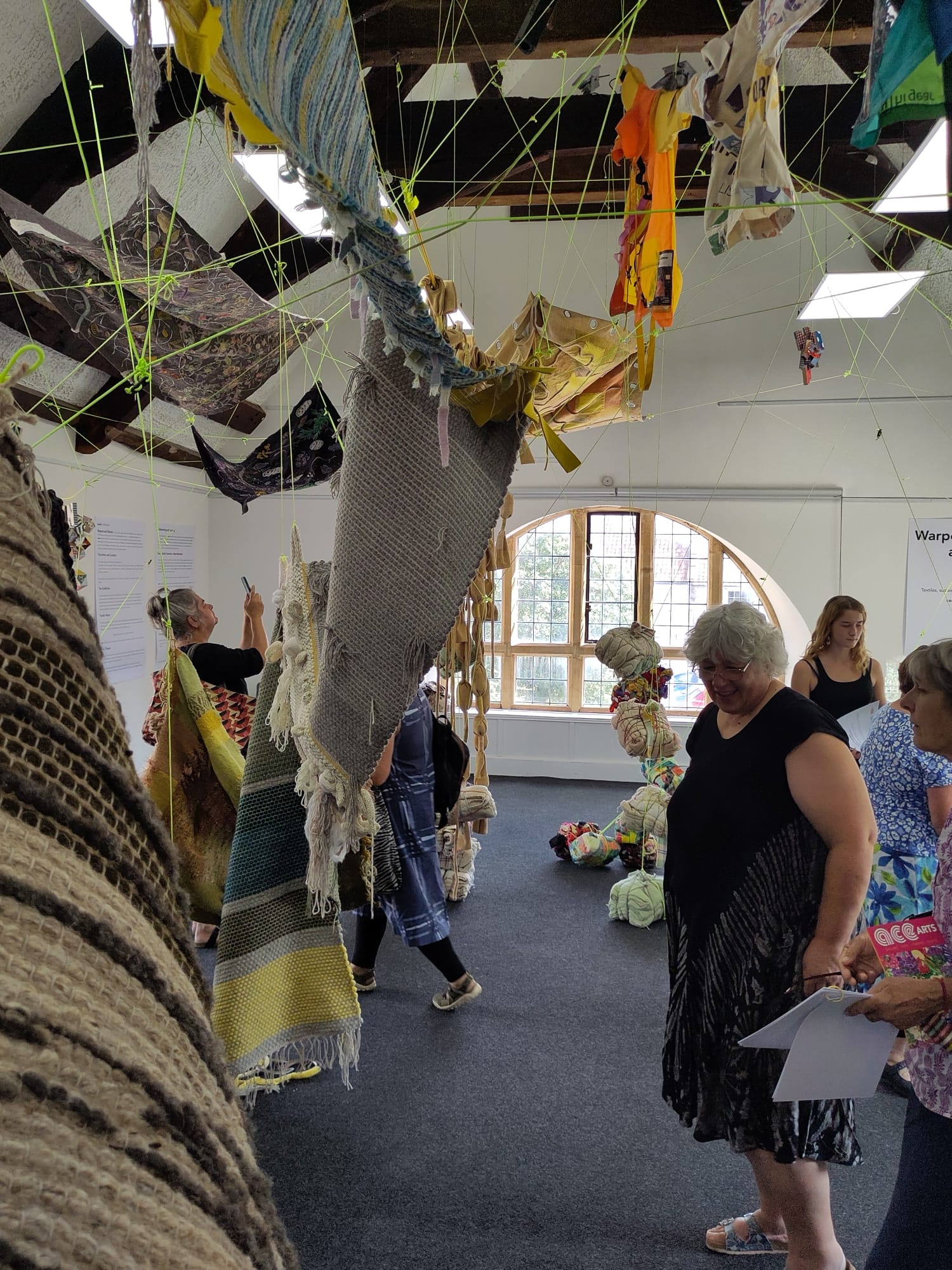
Warped and Wasted installation views with our first visitors
The guy ropes are purposeful and we referenced Chinese washing line images. Having rules was essential to keeping it clean and sharp. It could so easily have looked like a scrap store!!
As everyone’s work is so diverse, the common theme of connection, overlapping, sharing space, tension, softness and transition of colour holds it together. There are many metaphors that can be drawn from this installation and it’s presentation.
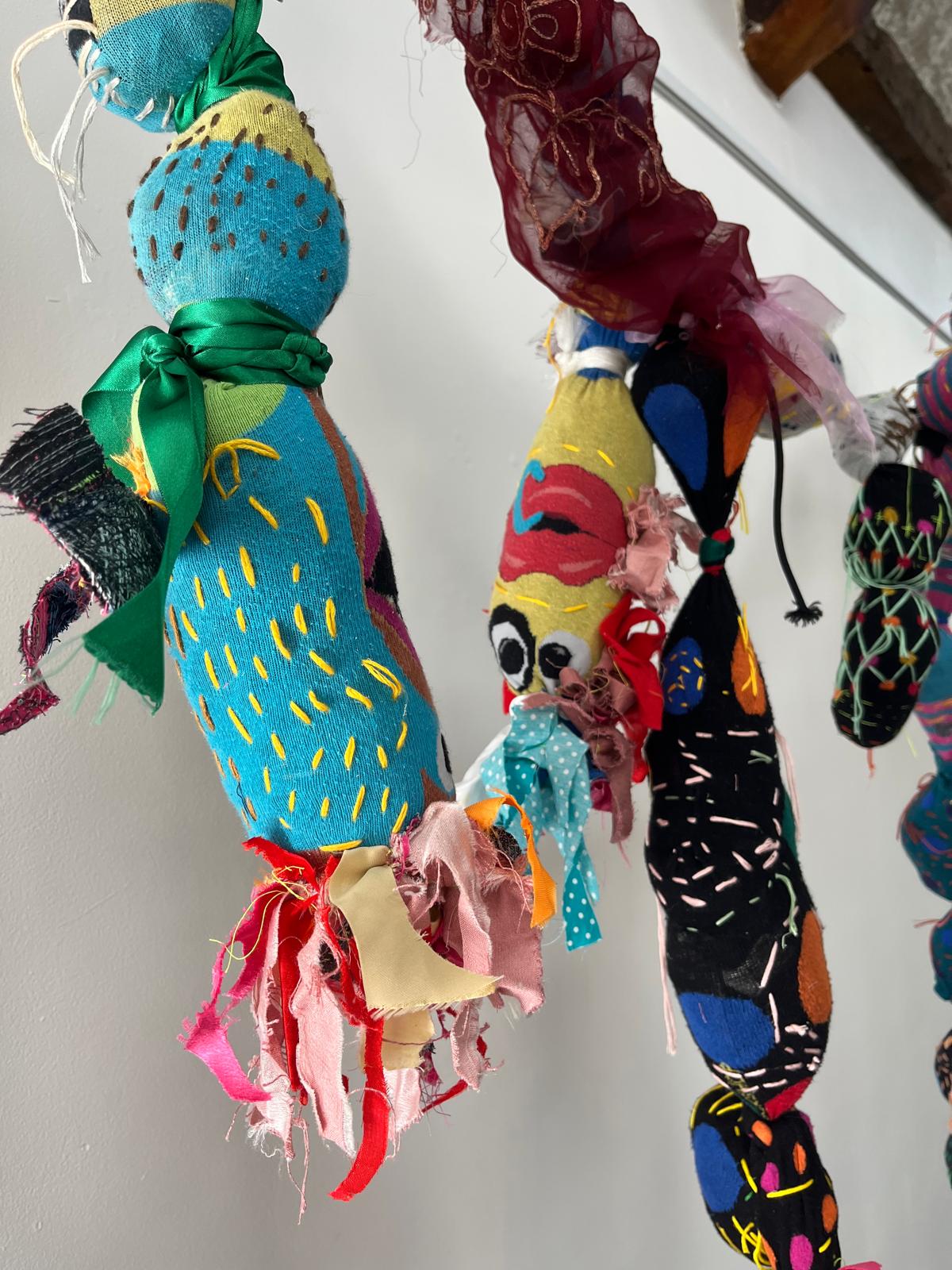

Joyful and colourful details made from scrap, from Oliver Bliss (right) and Jane Colquhoun (left)
Preplanning was essential as we worked through many iterations of how it could work. Nicola mocked up a visualisation and creating the framework of suspended guy ropes across the whole gallery and then introducing some of the pieces approximately around the room was the starting point. Hanging the rugs was a spontaneous decision and a commitment to the process. It became more difficult to navigate with the ladders as more work was hung so decision making was and had to be, decisive.’
It was exciting seeing how it grew each day and how the individual works started to have conversations with each other.
Nicola Turner
Questions
Oliver Bliss said that as well as the ‘rules’ he had the following questions in his mind installing the work:
- How can we let each piece speak without overshadowing others?
- What story does the exhibition tell as a whole?
- How do we invite the audience to look closer?
- Does this piece need to be here in this show or could it be saved for a future installation?
- Is there enough space to travel through the space accessibly
- Will people understand our collective journey?
- Is it inspiring and does it provoke discussion to help people consider sustainability in a meaningful way?
- Does this exhibition provoke discussion around fast fashion, waste and repair?
It’s over to you…
Warped and wasted was always going to be an ambitious and daunting installation. Our vision was a large scale, experimental art installation, which made visible our collaborative journey towards sustainability so far – the care, connections, compromises and complexities faced by each artist individually, and together in the collective.
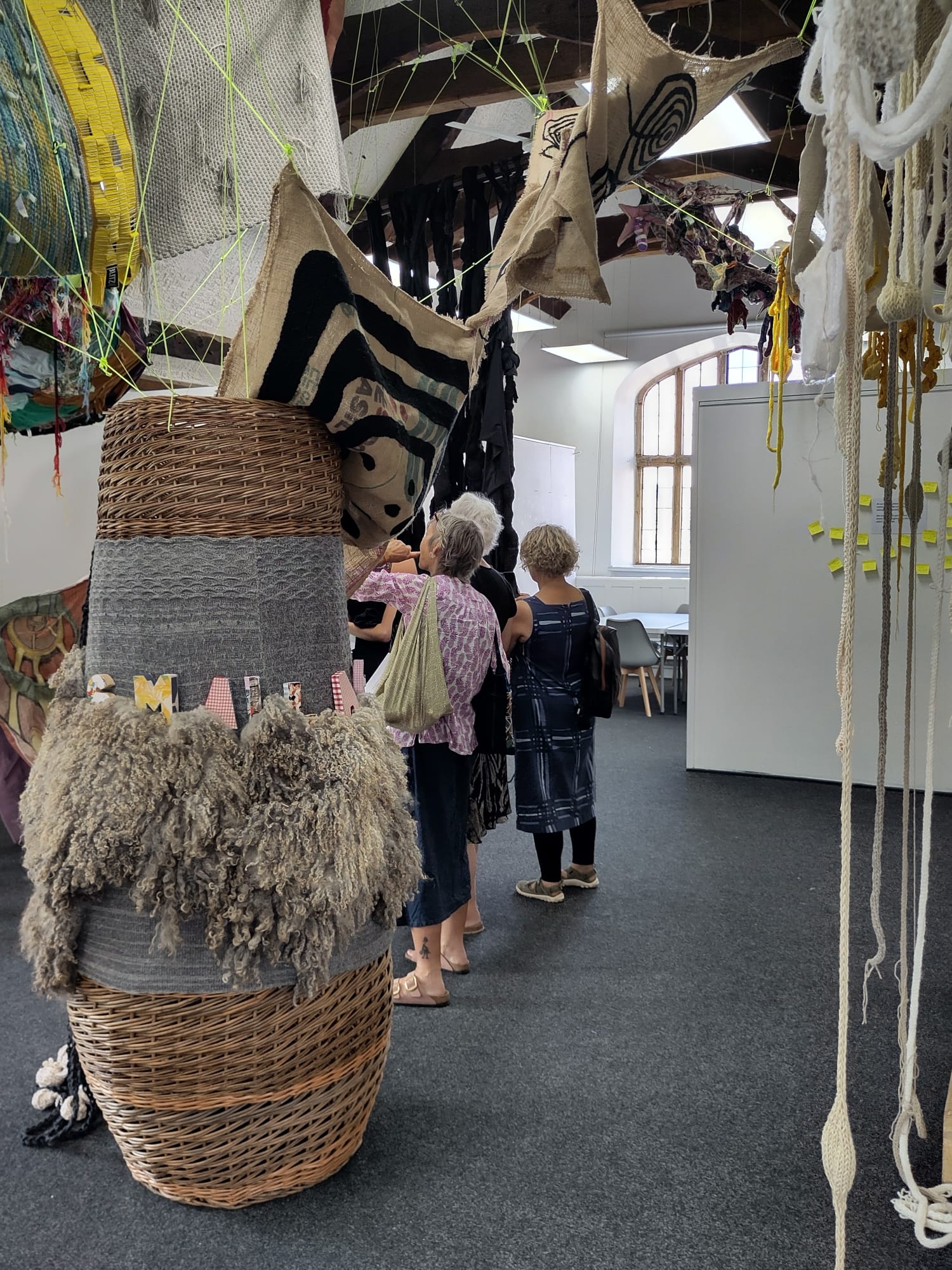
Warped and Wasted installation views with our first visitors and our questions wall for visitors to contribute their thoughts in the background
We think the curators did an exceptional job filling the brief but it is over to you, our visitors, to see what you think and to join our conversation – please do come and check out the exhibition, and leave your comments and questions either in-person or online – here as a comment or tag us on Instagram @seam_collective!
Many thanks also goes to the artists who made work for this exhibition, read more about their their individual pieces, their personal journeys towards sustainability and their responses to the Warped and Wasted project so far : Alice Marie Archer, Lou Baker, Oliver Bliss, Youngye Glory Cho, Jane Colquhoun, Julie Heaton, Desiree Jeans, Nina Gronw Lewis, Helen MacRitchie, Joy Merron, Lydia Needle, Angie Parker, Nicola Turner, Penny Wheeler.
Warped and Wasted – the exhibition:
Saturday 23 August – Saturday 11 October 2025,
ACEarts, Market Place, Somerton, Somerset, TA11 7NB,
Tuesday 11am-5pm, Wednesday -Saturday 10am-5pm. Free entry.
Warped and Wasted – meet the artists:
Saturday 30 August 2025, 11am-1pm,
ACEarts, Market Place, Somerton, Somerset TA11 7NB. Free entry.
Warped and Wasted – Textile talks: Textiles, sustainability and collaboration:
Friday 3 October 2025, 10am-4pm,
Somerton Parish Rooms + ACEarts, Market Place, Somerton, Somerset, TA11 7NB
Book your tickets now! Come and join the conversation…

Thanks to Lydia Needle and Nina Gronw-Lewis for the photographs of the installation.
 seam
seam 