I joined seam collective in early 2023, walking into a moment already brimming with momentum. A Visible THREAD had been imagined, funded, and even launched with its first exhibition. I was incredibly fortunate—invited into a living, breathing project that already had a pulse.
For someone like me, deeply embedded in material and process, A Visible THREAD offered the rare opportunity not just to make—but to test, reconfigure, and grow across more than a year punctuated with public facing moments. I am usually a few steps ahead in my mind from what I am making day to day, so when I show my work, I naturally tend to resist finality. Each artefact is not so much a conclusion, as an iteration. A Visible THREAD, with its structured constellation of exhibitions and its culture of shared support, became the ideal incubator for this thinking through making.
The accessibility of A Visible THREAD was career-making for me, as an artist mother to – at the time – a pre-schooler, now a child in primary school. I can share that even today, I choose being an active participant in my child’s early-years over opportunities to develop my practice on an almost daily basis. For me to say ‘yes’ to artistic opportunities they have to have certain qualities in order to be accessible. A touring exhibition where all the venues were in the South West is really something very special. The addition of the opportunity to contribute as part of a collective of practitioners, acting as a moving sea of support and acceptance, is not something I could have done without. Where the village that it is supposed to take to raise a child has been woefully absent, I have found the village it takes to raise-up an artist-mother in seam.
Unearthing the jacket
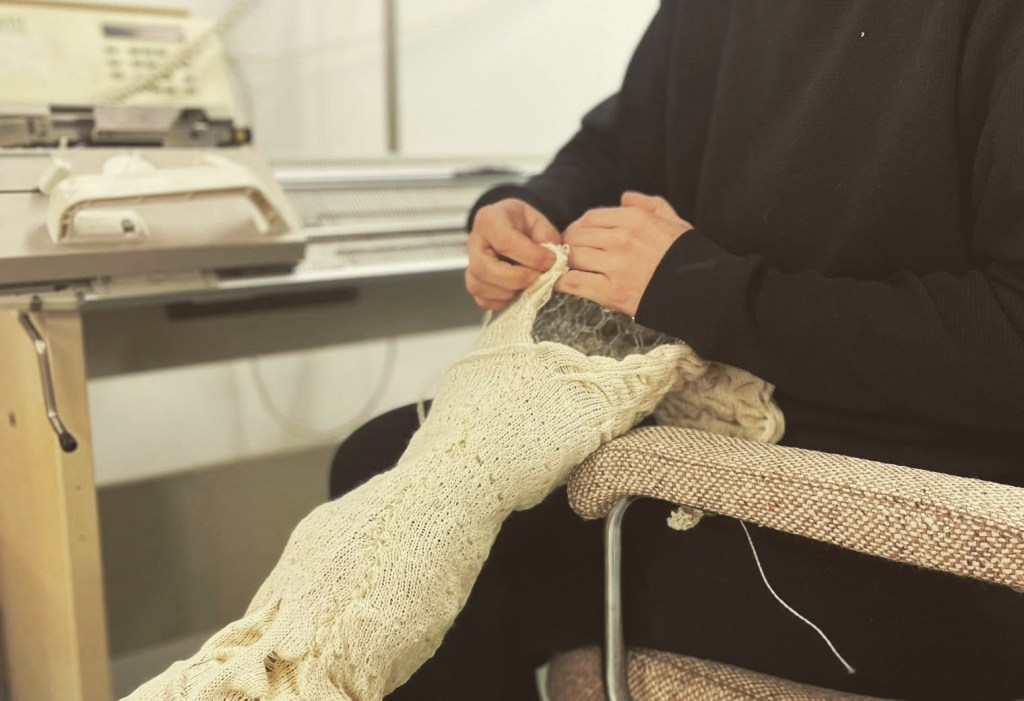
The first work I offered to A Visible THREAD was UnEarthly Jacket, shown at both Fine Foundation Gallery in Swanage and Black Swan Arts in Frome. Its story began with leftover hydroponic textile substrates from my Knitting Nature exhibition at The Garage in Bristol. Originally machine-knitted from Romney wool sourced from and spun at Rampisham Mill, the material had already lived one life—seeded, germinated, and grown hydroponically. When faced with these remnants, a little degraded by the process of being cultivated, textures selected through much experimentation in order to support specific seedling growth I was curious about what knowledge they held – what story they might be used to communicate.


Rather than discard these remnants, I chose to remake. In UnEarthly Jacket, I returned to World 74—a speculative future I had proposed in 2021 for Amy Twigger Holroyd’s Fashion Fictions (Holroyd 2025). In World 74, clothing is made from textiles used initially for food production – in a way cultivated rather than produced. In that world, garments are not fixed but mutable, grown and regrown. Inspired by the geographical variance of knitting patterns around Europe and beyond; in World 74 the texture on an item of clothing, could tell you about the food culture of region of the person that made it – for example a certain texture selected to be favourable for growing peas. UnEarthly Jacket was my play within that world—something lived, remade, worn.
‘The order is reknitted: human beings are with and of the Earth, and the biotic and abiotic powers of this Earth are the main story.’
Donna Haraway (Haraway, 2016)
Hosting the living
At Llantarnam Grange, I installed a sample made for Stitch Field, created ahead of my work for the Benton Museum of Art. In this moment of my practice, how my living artefacts might be cared for whilst installed was of high importance to the success of my practice. Showing living work is really challenging, and installing living artefacts for extended periods, far from where I, myself, am – means I can’t be there taking care of the work myself.
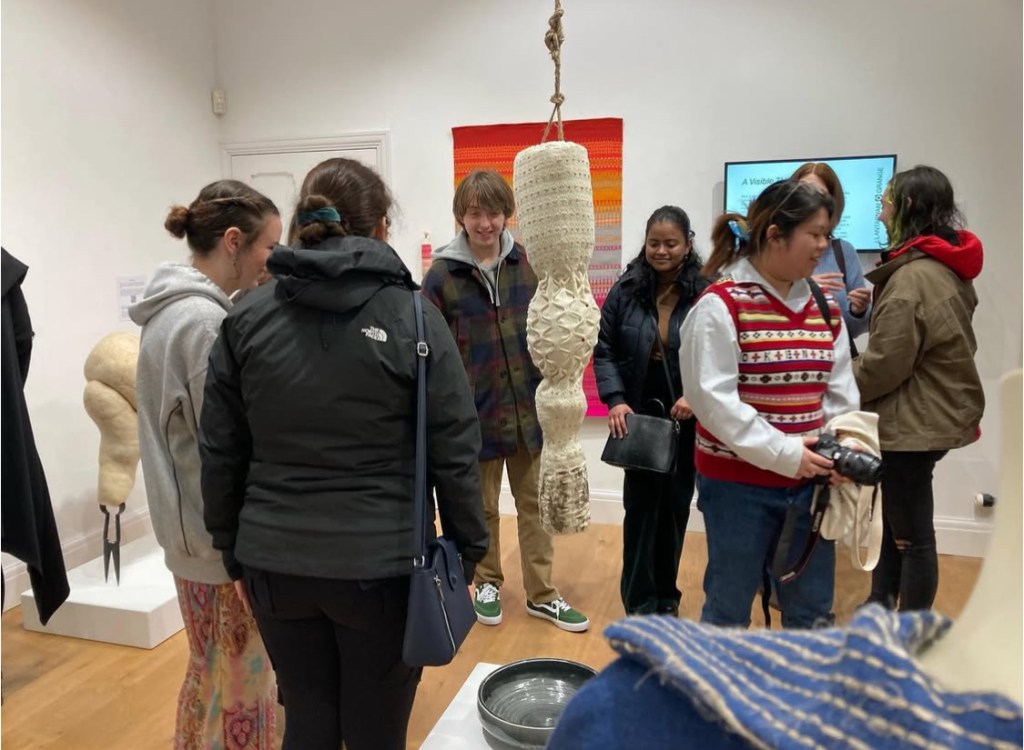
Suspended from the ceiling, this piece included a ceramic vessel in the neck from which water was wicked into the sculpture, flowing downward and dripping steadily into a tray below.
There’s something disarming about living work in a gallery. It unsettles conventions. The piece needed regular watering. It changed day by day. The team at Llantarnam were wonderfully open—curious about the work, happy to engage with its unpredictable nature. This mattered. As soon as a piece asks to be tended, it shifts how we encounter it. It aligns more with performance than display. There is something quiet and ritualistic in the ongoing being-with of these works. They are not static. They require presence.

The piece eventually stopped thriving and this too was insightful. Just how much decay are we ok with? How can this be built into performance in a designed manner as opposed to coming across as haphazard or failure of the work? I find this shift powerful:
- Living textiles invite intimacy.
- They invite you to notice subtle change—root, shoot, seed but also wilt, mildew, mould.
- They introduce rhythm, a tending.
I think here of Katy Conner’s hydropoetics installations focussed on ecology and practice of care.
Ritual vessels: hydrollas and ancestral water carriers
Halfway through A Visible THREAD, I began a new chapter supported by Arts Council England’s Developing your Creative Practice grant. I was exploring how irrigation vessels—ceramic forms—could become both functional and spiritual components of my work.
My research took me deep into ancestral technologies: ollas—unglazed ceramic vessels used across Central America, Iran, and parts of China. Buried in soil, these porous pots slowly release water, responding to the needs of nearby roots. I was fascinated. Could this work within seeded textiles, where the ‘soil’ is a knitted membrane?
As usual, I began with the materials—testing clay bodies, levels of grog, firing temperatures. I watched how the vessels ‘breathed’—how osmotic pressure moved water through ceramic skin. What emerged were vessels with both a functional and emotive presence.
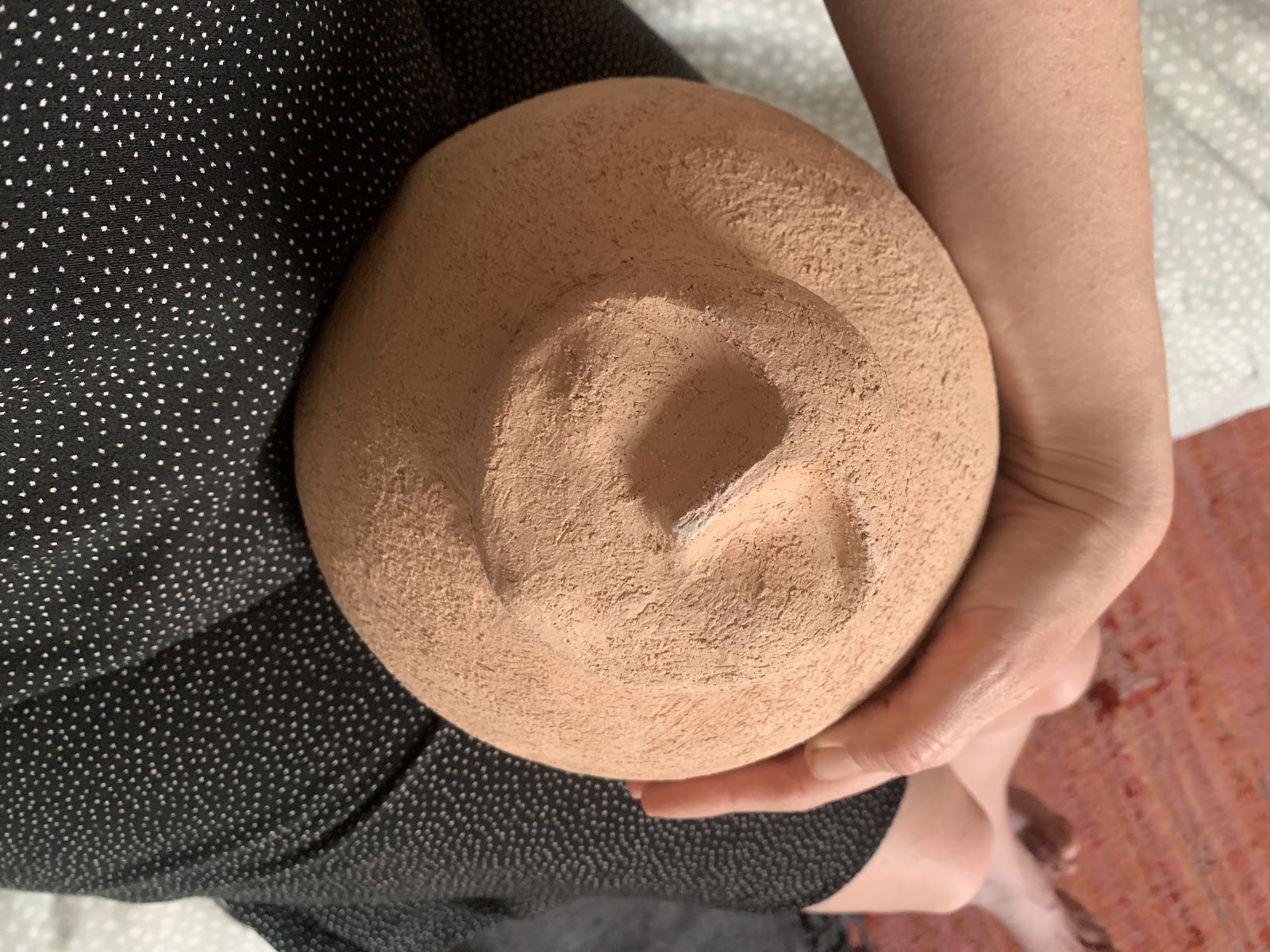
The vessels I made with Thelma Hulbert Gallery in sight were round and ‘full’. I had been thinking about the sun, and moon and water and how I might represent a cosmology of nurturance in these vessels. I made the bases totally spherical, in order to make them movable, flexible, and sitting them on shallow bowls designed to support them and receive any water that drained from them. The fullness of the vessels – recalled unexpectedly, my own once pregnant body, once full of waters. The hydrollas felt protective. They fed. They offered. I started shaping lids with faces. I started to think of the vessels as guardians or stewards of the plants. As Mothers.
An invitation to relationship
At Thelma Hulbert Gallery, something changed. The addition of lids—with their gentle, open faces—seemed to alter how people related to the work. Gallery staff began noticing daily changes, emailing me to share that: ‘We’re amazed at how quickly it grows and how much it’s changed in a short time!‘.
Maria Puig de la Bellacasa’s book Matters of Care (Puig de la Bellacasa, 2017) speaks to how ‘worlds seen through care accentuate a sense of interdependency and involvement‘. In making living artefacts, I am conscious that they are my invitation to whomever interacts with them to experience with the world in some sort of designed manner. At this experimental moment in my practice – I wasn’t sure what interactions the pieces would engender.
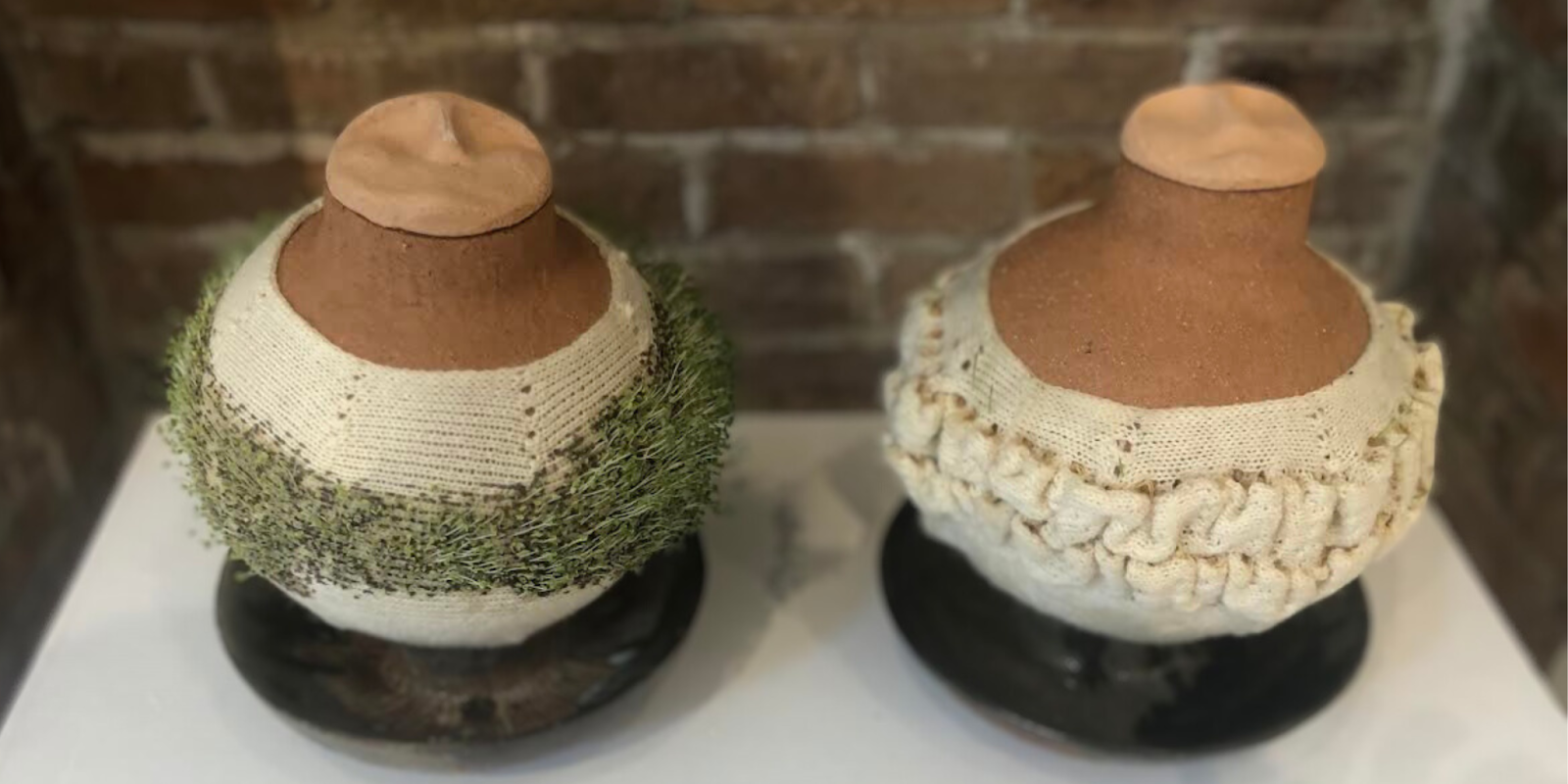
At Thelma Hulbert Gallery the curatorial team moved the vessels outside when it rained. Brought them back in. Tended them as living things, not as inert objects. It made me wonder: had the animist quality of the vessels prompted this shift? Did it invite people into a different relationship than the plants alone?
Thinking aloud – the idea that objects can be more-than-object—companions, collaborators, caretakers—is not new. But to see it unfold in a contemporary gallery setting was profound. These were not passive sculptures. They were active presences and moreover the curatorial team were touched by their presence.
Looking Ahead: Stitching for Restoration
Since A Visible THREAD, the hydrollas have continued evolving. The two I first showed at Thelma Hulbert Gallery now feature in the main gallery of V&A Dundee’s Garden Futures: Designing with Nature exhibition where I made new skins for these based on traditional Scottish knitting patterns Sanquhar and Gansey.
Seven more recent iterations of hydrollas form part of the (free to the public) interactive zone Stitch to Seed in V&A Dundee, which I developed alongside the curatorial team to explore how craft, community, and plant science can support ecological restoration. Deliberately rudimentary these invite viewers to imagine they too might approach this kind of practice.


Alongside the new hydrollas, Stitch to Seed includes stations for hands-on engagement and a large-scale geotextile quilt—Repairing the Riverbank—designed to prompt questions around care, regeneration, and repair. In these works, the boundary between the textile, the vessel, and the land becomes porous.
Stitch to Seed and Garden Futures; Designing with Nature run until end of Jan 2026 at V&A Dundee.

Closing Reflections
In their book Women who make a fuss, Isabelle Strengers and Vinciane Despret (Strengers and Despret, 2015) extend on expressions from Virginia Wolf on the idea that ‘making a fuss’ is not about blanket dissent, but about daring to ask the kinds of questions that unsettle what usually goes unquestioned. For Strengers, Despret, and others there is something to be said for allowing ourselves to be troubled by the world around us, and for that trouble to become part of our thinking.
Textiles offers abundant language for fuss. I think about A Visible THREAD, and all the fuss we are making over here – not so much with words but in our visible threads, our multivariant expressions of dissent. I entered into this chapter of my practice because I was unsettled about the hydroponic sector (that I had been working adjacent to) and what has been normalised in its rapid, industrial uptake over the past 30 years. I think of my practice as being in the space of sort of speculative-counterstory, an expanded imagining of what hydroponics could be, valuing material, place and craft knowledge.
My experience of textiles practice growing up was that textiles if it was decorative was fine, but if it was thinking it was probably weird, queer, to be ridiculed or trivialised. Strengers and Despret echo Wolf in expressing that fuss making comes at a price – pointing to how for Wolf, the price of ‘being troubled by the world around us and that trouble being part of our thinking’ – might be to be unsupported, underfunded, or dismissed, which I feel echoes what was happening in textiles for a time. Strengers and Despret also echo Wolf to point out that – the salve is to remake our world together in community with like minded others – collectives of thought where differences are not problems but resources.
Ultimately for me A Visible THREAD was not simply a platform—it was a constellation of opportunities to test, stretch, and root new ways of working and with seam as the sort of fertile ground for that to occur. What I take away from A Visible THREAD – the measure of its success for me – was not in the work that I shaped, but in how thinking-through-making and in interacting with the other members, that the work shaped and continues to shape me.
Alice-Marie Archer
select References
Haraway, Donna (2016) Tentacular Thinking: Anthropocene, Capitalocene, Chthulucene, in e-flux Journal Issue #75, September 1, 2016, available at https://www.e-flux.com/journal/75/67125/tentacular-thinking-anthropocene-capitalocene-chthulucene accessed on 25/07/25.
Puig de la Bellacasa, M. (2017) Matters of Care: Speculative Ethics in More Than Human Worlds. United States: University of Minnesota Press.
Stengers, Isabelle, and Despret, Vinciane (2015) Women who make a fuss: The unfaithful daughters of Virginia Woolf. University of Minnesota Press.
Twigger Holroyd. A. (2025) Fashion Fictions: Imagining Sustainable Worlds. Bloomsbury Academic.
 seam
seam 