We hit the ground running with this third Warped and Wasted group meeting at ACEarts HQ, following on from Collaboration Meeting 1 and Collaboration Meeting 2. If we were to sum up the day with one word it would be consolidation. We attempted to rein in the themes from the previous sessions and nail down the core aspects of the project so that we could all move forward with workable boundaries.
Challenges
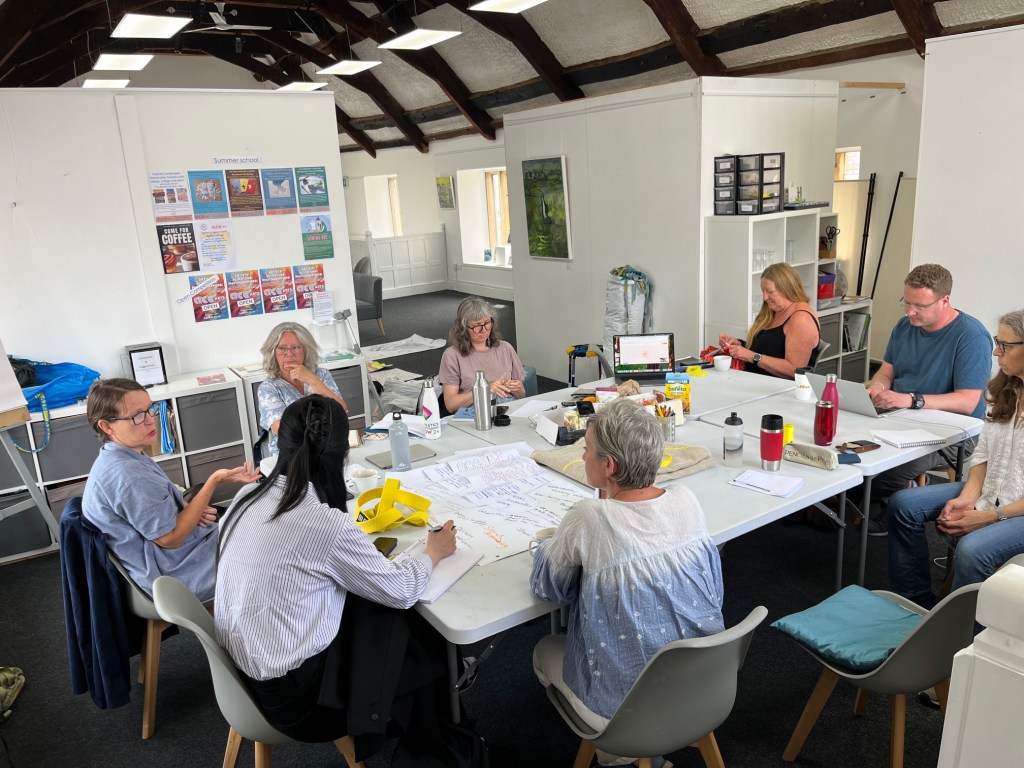
Early on in the day we acknowledged the difficulties we faced when working collaboratively with a large and diverse group. The biggest challenge that we’re working to overcome is that it is seemingly impossible to have everyone present for the meetings due to individual work commitments and life situations. Unexpected illness for one of our mentors and members impacted attendance for this meeting too. To resolve some of these limitations we had two member join us remotely which helped to bridge the gap.
An unexpected benefit of carsharing for four attendees was that it allowed us to review the project so far on the journey down as well as reducing the fuel used for transport.
Sustainability discussion
The first part of the session was discussion based. A review of the homework assignment set by our sustainability mentor, Judith van den Boom revealed a common theme that we all want to pay more attention to what happens to the things we make for the exhibition once the event is over – thinking about the full cycle. This is not only in the short term of selling or re-using the artworks, but taking it all the way to how the materials will break down when they are no longer fit for purpose. An ideal scenario for many of us is that the work will be composted and regenerate the soil in the process. With this in mind we will look at identifying and testing the fibres and where possible will separate biodegradable from non-biodegradable in the gallery to shine a light of the choices we are making when selecting materials.
Questions and decisions…
Mentor, Helen Carnac, guided us thorough the day by asking questions to help us all to dig deeper in our thinking and planning.
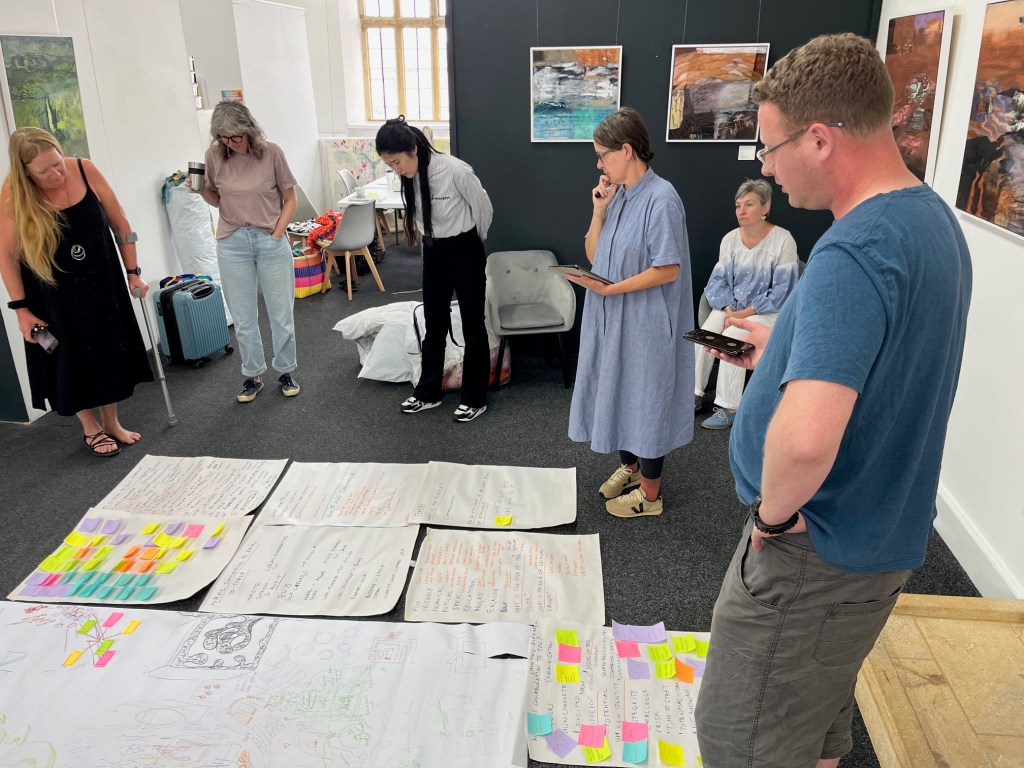
We collectively agreed to make individual works which are modular so that we take on responsibility for our individual pieces.
What is our collective bottom line that we don’t want to cross?
- Do we need to review our stashes and consider the items that need to be separated in terms of items that can’t be composted, items which have been constructed through non-ethical/ inhumane means?
- Are there textile materials in our stash which are unethical and against human rights/ animal rights? Can we have a system together as a group that makes it easier to identify these items?
- Things that are dyed can be an issue because of the processes they undergo, the way in which the waste product from the dye is disposed of, and potentially toxic residues when composting.
- We need to also consider the process of handling waste product and the reasons why we would want to use it in our own work.
- Can we transform waste fully to become a completely new and unrecognisable product?
Could we map out different approaches to sustainability within the space?
Can we work out and map our journey from using existing waste to moving into an era of design which is purely working with materials that are truly regenerative? – Is that even possible?
There is a desire to still show labels that are a part of the work, showing the journey of the materials from where they originated. This includes products that we don’t have a full history of because they were donated. (It might be possible to identify certain patterns based on google pictures?)
We were eager to move into the gallery space to continue the discussion and covered some difficult and challenging topics on a local and global level, including visitor expectations and experiences, and an awareness of the impact of imposing our western ideologies on the complex infrastructure of global manufacturing. The discussion really helped us to consolidate our thoughts on this vast and multi-layered topic and with Helen’s questions we worked on how the artworks would present these themes to our audience.
Our exhibition title, Warped and Wasted, feels more relevant than ever as we grapple with these varied questions and issues.
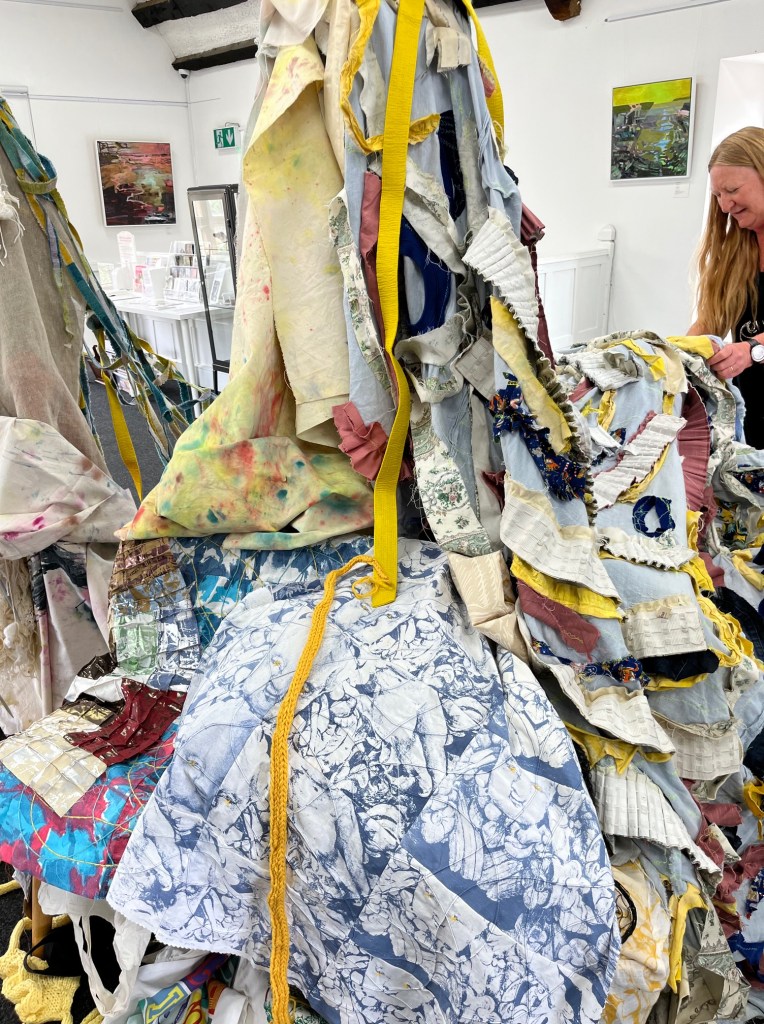
There is too much to cover in this blog post but there is a clear sense that we are actively learning and engaging together to learn from one another. We need to be able to translate this back to audiences so they understand where we came from and where we are now.
Playing in the space with work in progress
After lunch we had a play around in the space with materials and preliminary examples of new work for the exhibition. This helped up to visually workout some of the curatorial challenges we need to focus on.
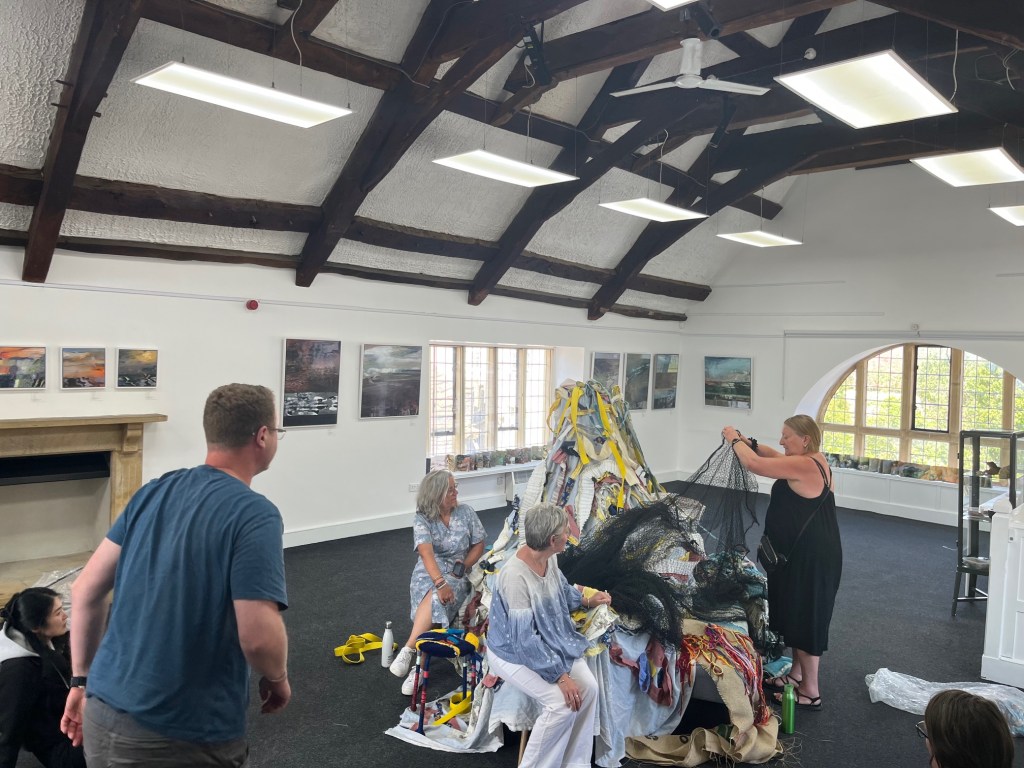
We were careful not to limit the creative process at this stage and the options for making include
- Wall hangings
- Individual pods
- Floor area
- Hanging pieces
- Furniture clothed
- Free standing piece
- Neutral Work
- Loud Work
- Mixed Work
- Quiet Work
- Small Work
- Large Work
What doesn’t come across in the photos of the day is the laughter in the room. We are generally keeping to our goal of being able to discuss difficult and challenging topics regarding sustainability in a safe and supportive way. Each person in the group was listened to and felt heard in the space.
It was very much a meeting where we were thinking together out loud, we asked lots of important questions but by the end of the session we hadn’t found all the answers – a sub-committee was tasked with the next challenge; answering some of the those questions and curating the exhibition. Let the making commence!
Watch this space for further Warped and Wasted developments and save the following dates:
Warped and Wasted will be at ACEArts from 23 August- 11 October 2025. We’re also planning a day of talks about textiles, sustainability and collaboration to accompany the exhibition on Friday 3 October in Somerton, so please come along and join the conversation.
Angie Parker
 seam
seam 