Waste into wonder? Stitching together a giant patchwork of ideas…
Warped and Wasted – with Judith Van Den Boom, at ACEarts, Somerton
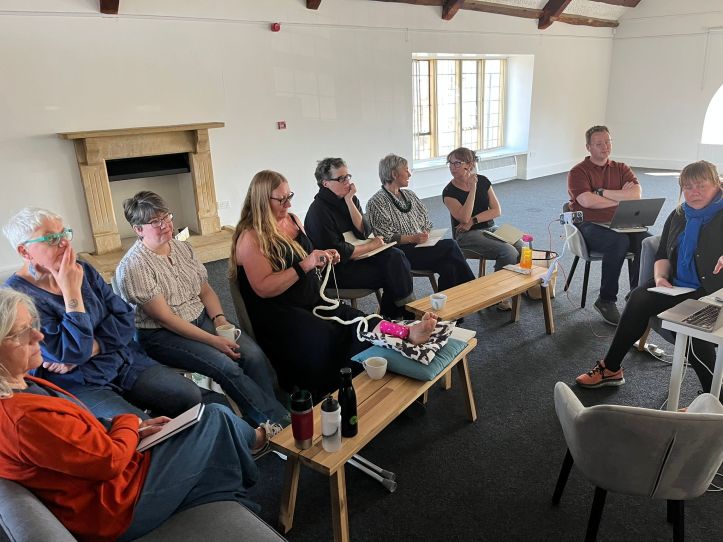
It’s always very special when seam collective gets together in person. We don’t do it very often as we hold our monthly meetings online, but it’s just not the same as seeing one another face to face! Consequently, it’s been very lovely to have gathered twice recently to plan our next exciting project, Warped and Wasted. It’s so good to be able to catch up with one another properly, but its also much easier to have a discussion and to develop practical ideas. For details of our first planning session, please see Angie Parker’s blog post Collaboration Meeting 1.
This time, we met at the wonderful ACEArts Gallery, in Somerton, Somerset, where we’ll be installing the final Warped and Wasted installation, whatever form it takes! Two of our members, in fact, run ACE Arts – Nina Gronw Lewis and Lydia Needle – and I have to say that they are the hosts with the most! Thank you both.
And today we met our second, invited mentor for the first time. Judith Van Den Bloom has had many years’ experience, working internationally, teaching sustainability and facilitating collaboration. This expertise is just what seam collective needs for our Warped and Wasted project. She is currently the Course Leader of the MA in Regenerative Design at Central St Martin’s in London.
We spent the morning learning more about Judith and her work and discussing some of the amazing, regenerative projects she’s been involved in. We have a lot to learn!
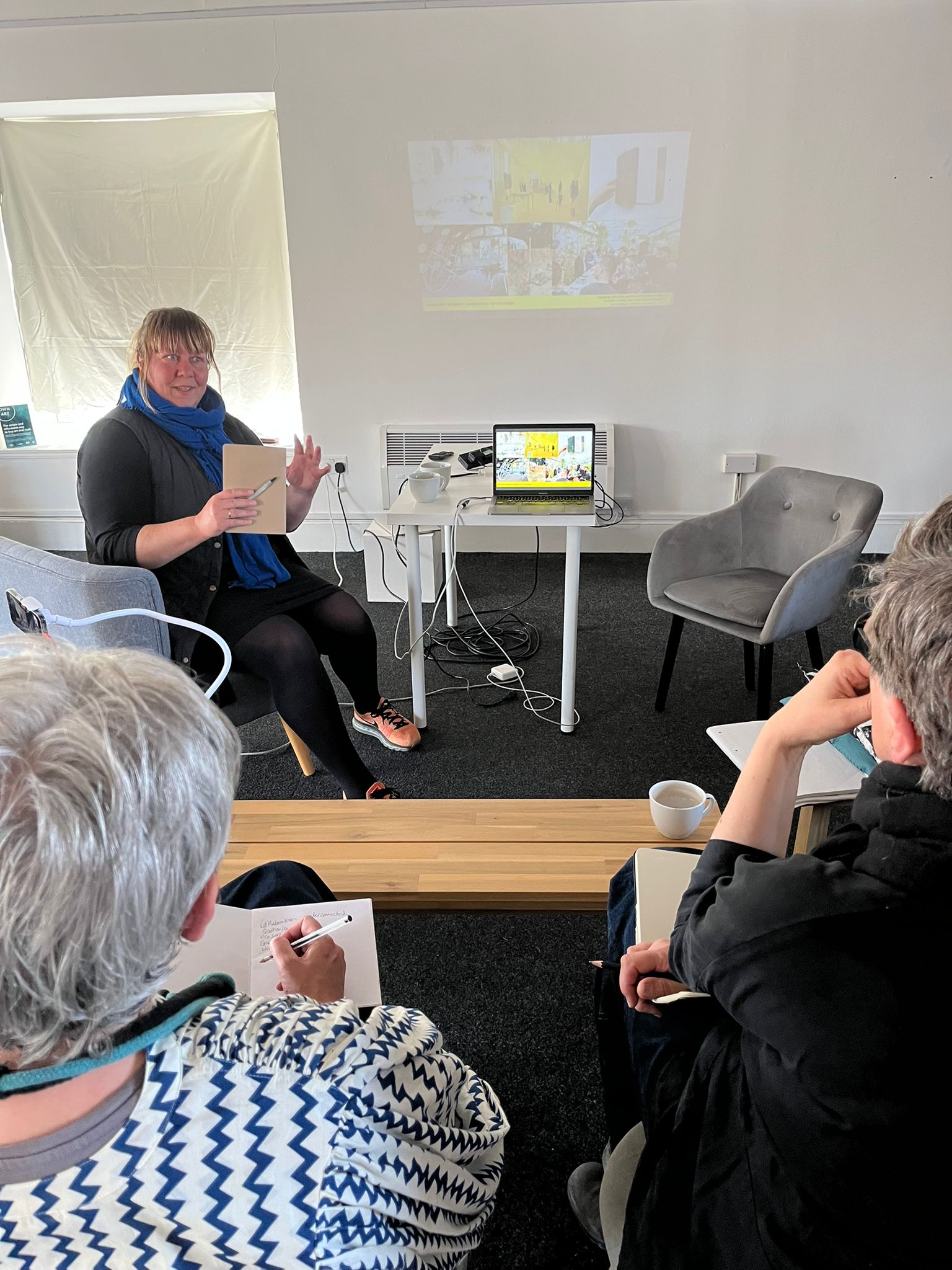
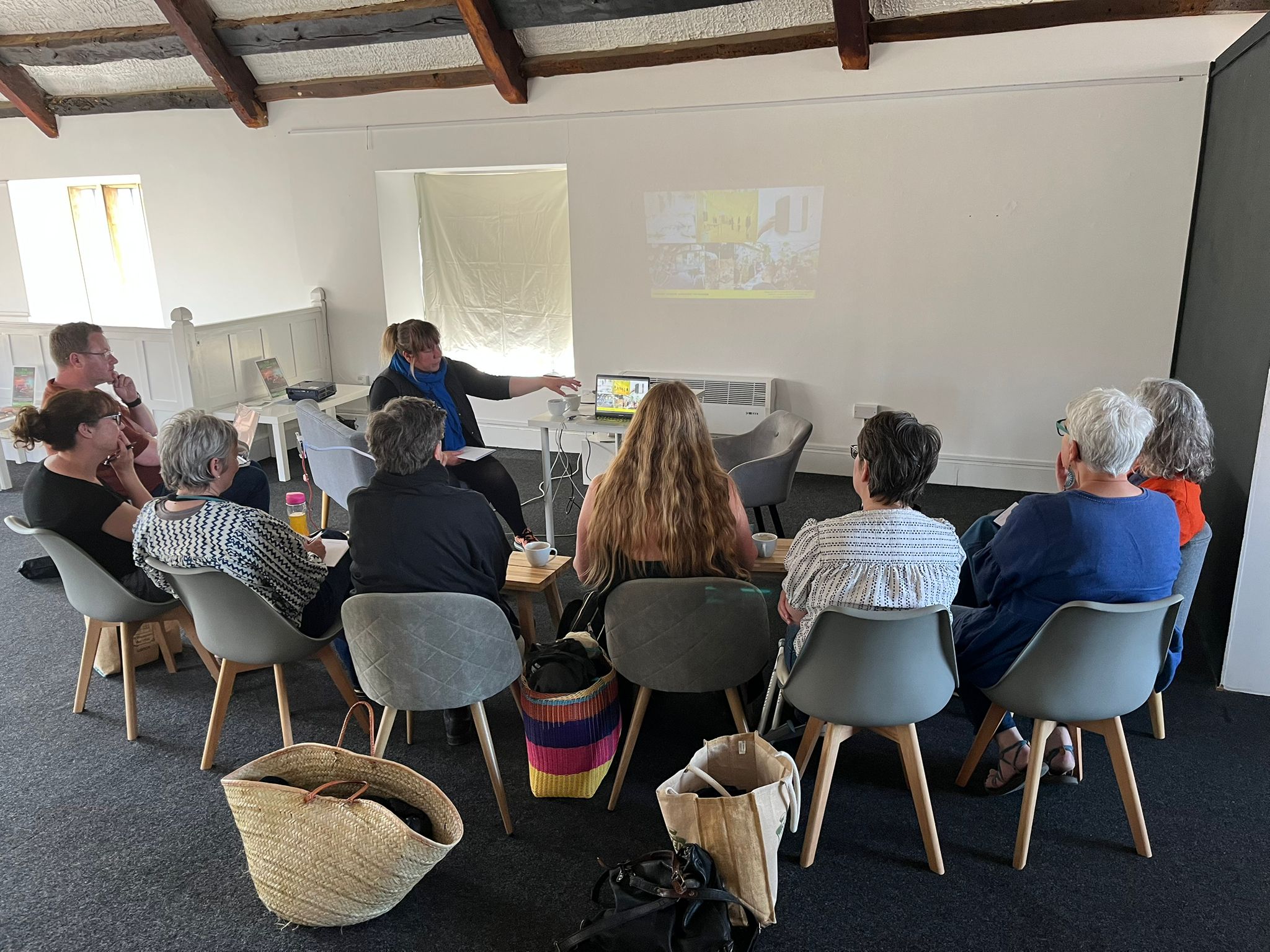
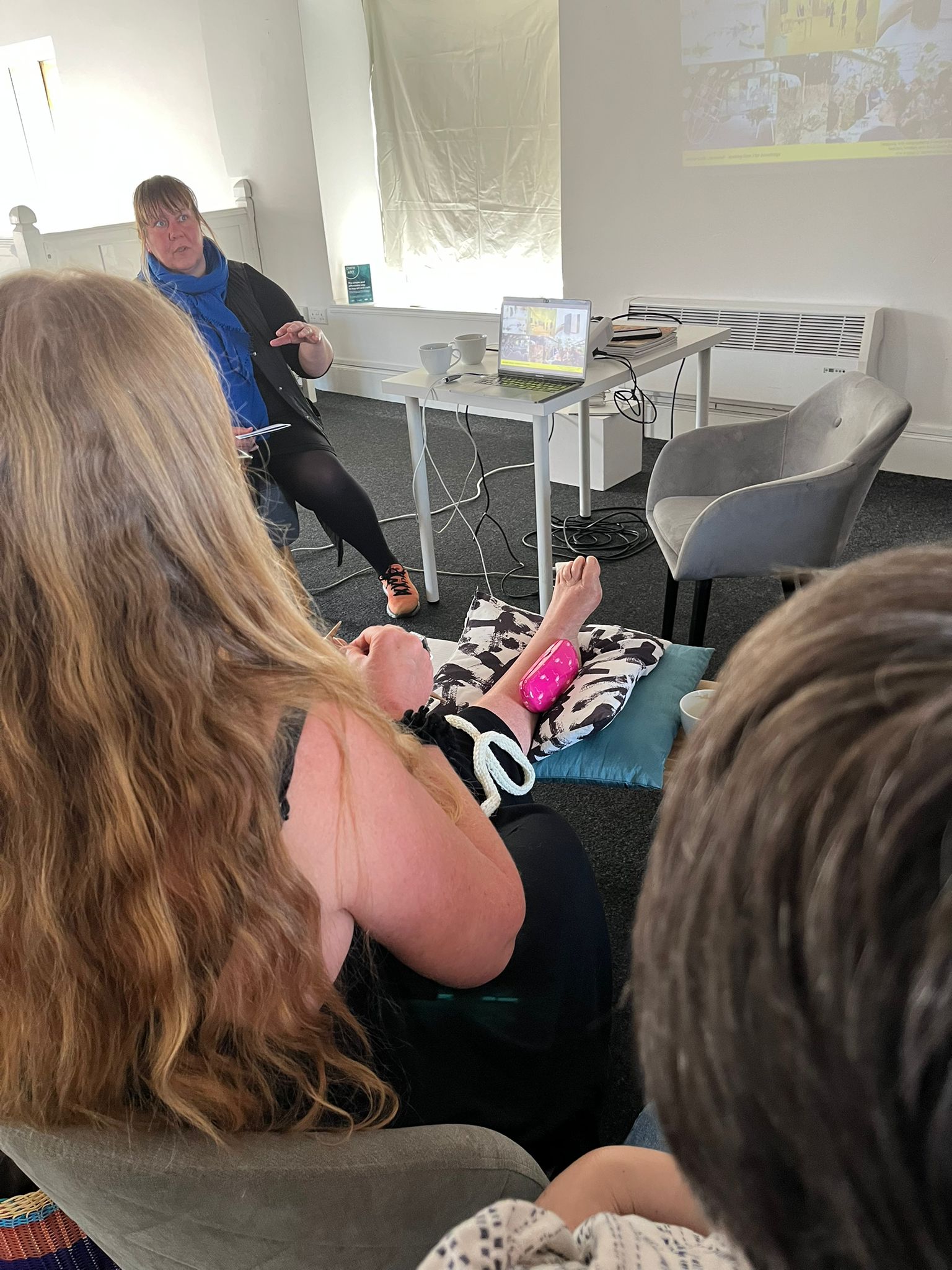
Judith van den Bloom sharing her knowledge
One thing that struck me forcibly was the connection of care between textile and regenerative work. There’s so much to think about.
Germinating ideas…
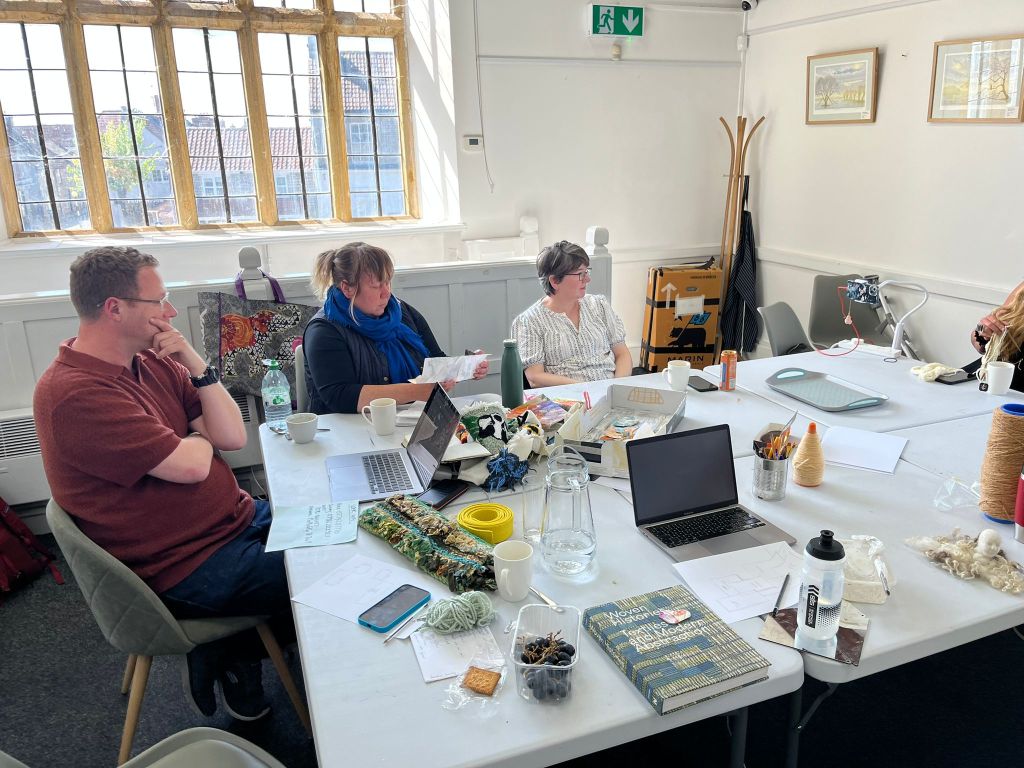
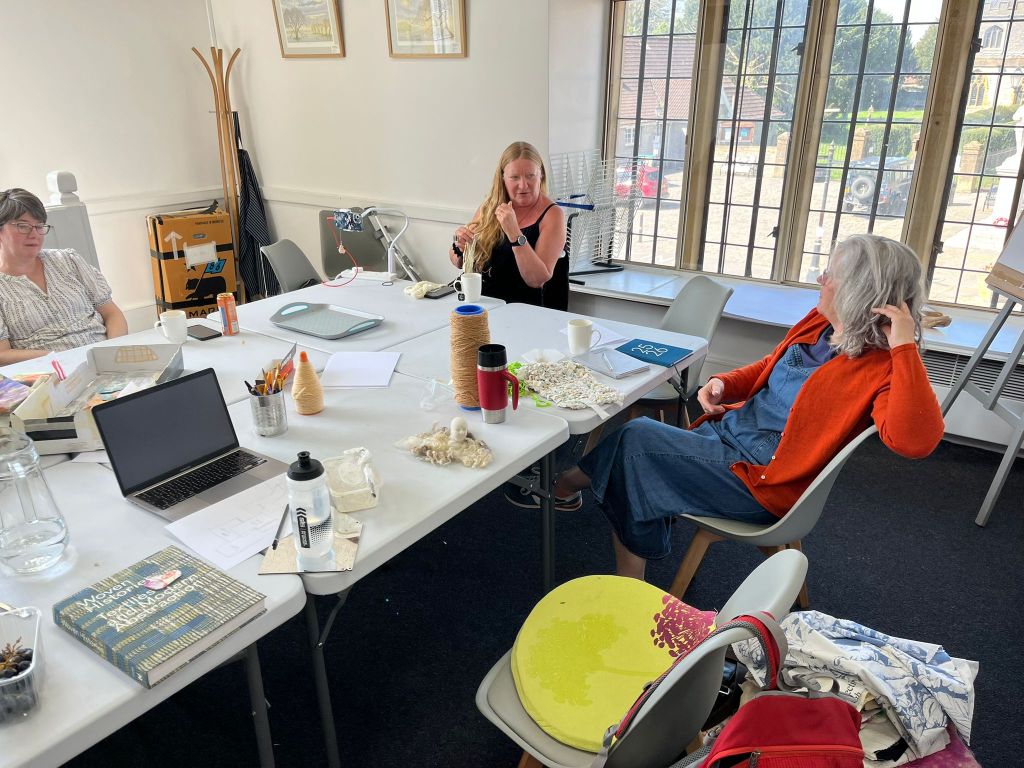
Over lunch we decided to make some space to talk about the ideas that have been germinating since our first Warped and Wasted collaboration meeting with Helen Carnac. Since that very inspiring meeting, there have been lots of practical ideas bubbling up amongst the group, so it was wonderful to be able to discuss them around the table. We initially suggested that everyone would speak for a minute, but in fact, what followed was a highly engaged, creative and lively discussion about what we might make – what materials we might use, what form the installation could take and other important practicalities that we need to consider in order to bring this rather ambitious collaborative project to life.
How do we work together to make a plan to transform the gallery at ACEarts into a large-scale, collaborative installation that will provoke thought, conversation and action about the issues surrounding textile waste?
How do we work together to make a plan to transform the gallery at ACEarts into a large-scale, collaborative installation that will provoke thought, conversation and action about the issues surrounding textile waste? It was amazing to talk it all through, and we certainly made some progress in our thinking and planning. I think for many of us, not knowing what this project will be and not knowing how we’re going to make it has been rather unsettling, so it was a big relief to be able to express our concerns and talk through the possibilities.
‘The whole is greater than the sum of the parts’
It has been especially interesting to think about how we collaborate. There are 15 seam members and we all have very different and distinctive practices. We use a wide range of processes and materials, we have very diverse objectives and we make very different things! If you visited any of our A Visible THREAD exhibitions you will know what I mean. Some of the group have been involved in collaborative projects before – Joy Merron, for example, has worked with ceramic artist, Gill Bliss, over the past few years, as Mud and Thread, combining cloth and clay to create colourful, quirky vessels; last year, Lou Baker and Oly Bliss, as Baker and Bliss, worked collaboratively on a couple of commissions and created Glowing and Growing, a large scale, site-responsive, immersive and interactive installation.
But most of the time, most of us work alone on our own work, so it’s a big challenge for us to find ways that we can collaborate.
So, what is collaboration? I like this definition:
‘Collaboration is a partnership; a union; the act of producing or making something together. Collaboration can take place between two people or many people, strangers or best friends. To collaborate is to commit to the possibility of producing an outcome greater than one that would be developed in a silo. Really, to accurately define collaboration, you don’t have to think about it too hard.’ (Ultimo, 2024)
I really like the fact that, through collaboration and working together, we can potentially produce something that is more aspirational and ambitious than what we can make alone.
It reminds me of the saying ‘The whole is greater than the sum of the parts’, a phrase often attributed to Aristotle (but apparently misquoted!) (SE Scholar, 2019). But I do often think that about patchwork, how many disparate materials stitched together can form a glorious, unified whole, and in fact, that is one of the ideas we explored during our day together.
Nina and Lydia brought to the meeting a rather cute cardboard maquette, – essentially a transformed shoebox! – that they had made of the ACEarts gallery. They had added various different coloured paper and cardboard shapes to create a patchworked mini gallery, of sorts.
It was really helpful to see the idea visualised like this. The thought of transforming the space with a giant patchwork of diverse works, made with sustainable and stashed materials, was met with lots of enthusiasm and sparked more suggestions and ideas. It becomes a real possibility.
Of course, this is really only the beginning of a plan; we’re only part way through our collaboration discussions, so who knows what we will finally decide to make?
There are, of course, some concerns about the aesthetics and curation of a large-scale work made in this way, but these are just some of the aspects of the project that we still need to work out between us.
Decisions, decisions…
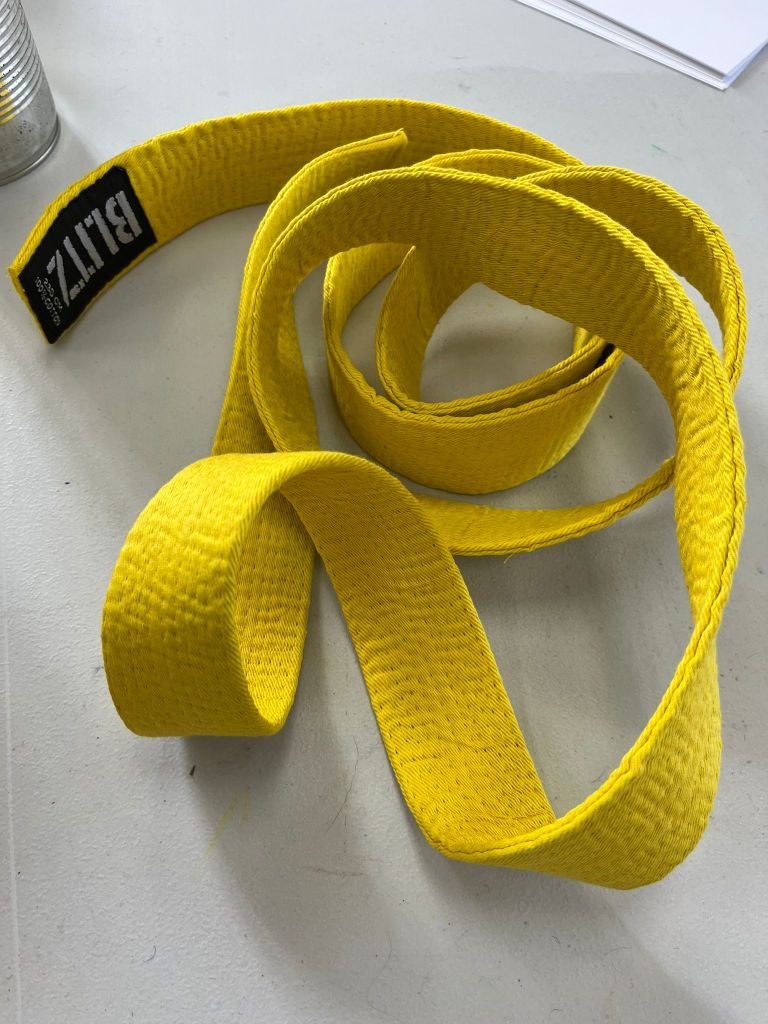
As a result of today’s discussions, however, we have made a few interim decisions. We decided that we would use a large stash of bright yellow karate belts that Nina has in her stash as some kind of connecting device between our disparate works. Yellow seems significant – in nature, its often used as the colour of warning, but its hopeful too… Angie also brought along some strips of gorgeous selvedge from her fabulous Bristol blankets. How can we incorporate these into our installation?
As makers, we’re also all very keen to start making, so for our next meeting we will all bring some large pieces of cloth from our stashes, manipulated, stitched of transformed in some way, to see if we can work out ways to physically ‘clothe’ the gallery, and maybe the furniture in it? Who knows what will happen? It’s exciting and, frankly, also rather daunting…
Watch this space for further Warped and Wasted developments and save the following dates:
Warped and Wasted will be at ACEArts from 23 August- 11 October 2025. We’re also planning a day of talks about textiles, sustainability and collaboration to accompany the exhibition on Friday 3 October in Somerton, so please come along and join the conversation.
Select references
S.E Scholar, 2019, Who said ‘The whole is greater than the sum of the parts’?, Available at: https://se-scholar.com/se-blog/2017/6/23/who-said-the-whole-is-greater-than-the-sum-of-the-parts
Ultimo, Caitlin, 2024, What is collaboration? https://blog.webex.com/collaboration/what-is-collaboration/#What%20is%20collaboration?
 seam
seam 
[…] third Warped and Wasted group meeting at ACEarts HQ, following on from Collaboration Meetings 1 and 2. If we were to sum up the day with one word it would be consolidation. We attempted to rein in the […]
[…] seam collective, from left to right Lou Baker, Nicola Turner, Nina Gronw-Lewis, Desiree Jeans and Oliver Bliss, with Judith van den Bloom in Collaboration Meeting 2 […]