Reflections on My A Visible THREAD Experience
Last summer, I had the privilege of presenting my work in A Visible THREAD at Thelma Hulbert Gallery — an experience that will stay with me for a long time. Exhibiting alongside the talented members of seam collective at such a distinguished gallery was both exciting and a bit nerve-wracking. I often wondered how my work would resonate in this context, especially alongside such diverse and innovative pieces.

A Visible THREAD was not just about showcasing individual works. Each artist from seam collective brought their own unique approach, from material choices to techniques. It was an exploration of the deeper stories that textiles can tell. It became clear that I was not simply displaying art; I was contributing to an ongoing conversation about the evolution of textile artistry, and that felt incredibly meaningful. The exhibition’s format encouraged collaboration and reflection, revealing how textiles are more than just materials but a medium that conveys history, culture, and personal narratives.
Inspiration and Movement in My Work
The central theme of my work has been the exploration of movement. For me, movement extends beyond mere physical motion to encompass broader concepts such as change, growth, development, and flow. To express these ideas, I chose weaving not just as a technique, but as an ideal medium for conveying movement.
‘The modern artist… is working and expressing an inner world – in other words – expressing the energy, the motion, and other inner forces’ (Jackson Pollock, n.d.). This inner world refers to intangible aspects such as energy, motion, and internal forces that go beyond the visible, physical realm. In other words, the artist’s role is not to replicate reality, but to visualize the unseen aspects of human experience, such as emotion, movement, and internal energy. This philosophy is deeply connected to Pollock’s ‘action painting’ technique.

Rather than using a brush to create controlled, detailed images, Pollock would drip, splash, and pour paint onto a canvas placed on the floor. Through this process, he physically expressed his body’s energy and motion, capturing every gesture and movement. The result was not a depiction of the external world, but a visual record of his internal energy and dynamic process.
Similarly, my work also focused on physically expressing the theme through the creative process itself. The repetitive act of weaving inherently reflects physical movement, and the rhythms and textures that emerge allowed me to explore not only literal motion but also the flow of ideas and emotions.

I was particularly drawn to how movement could be expressed through the tactile medium of textiles. By carefully manipulating the warp and weft, adjusting the tension, and controlling the patterns, I aimed to capture both motion and dynamic energy within the stillness of the textile. This process struck a delicate balance between control and freedom, allowing me to explore how the structure of textiles could suggest fluidity and change. In this way, my work challenged the static nature of the medium, offering a visual experience that implied constant motion, even within stillness.

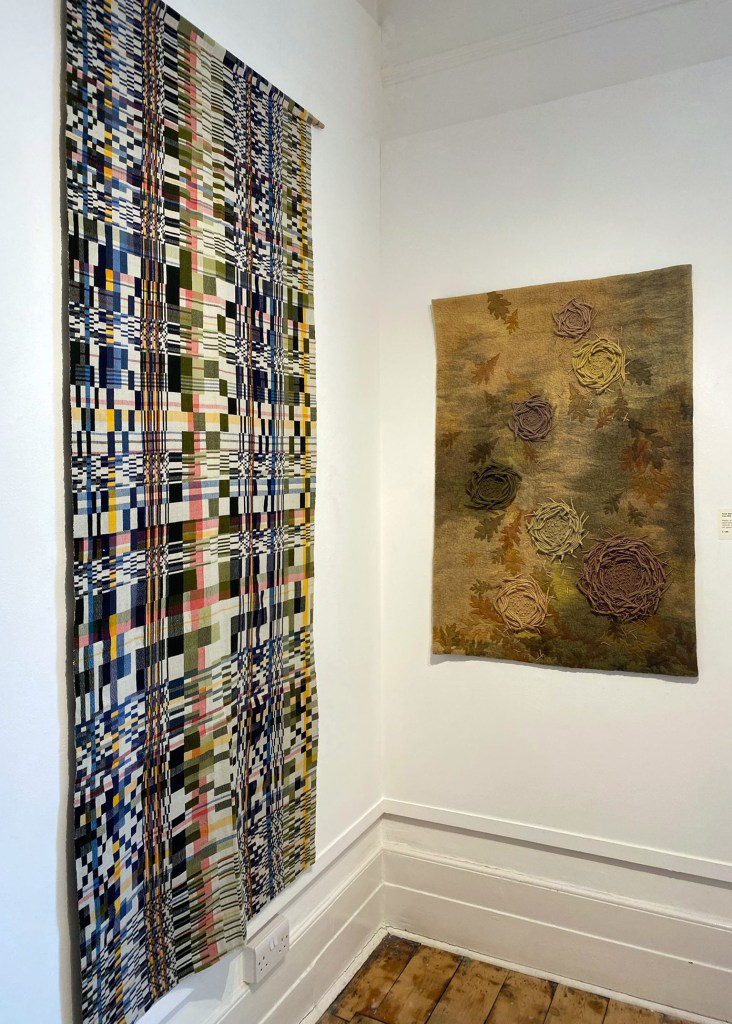
Youngye Glory Cho ‘Movement’, worsted wool, hand woven
For my piece Movement, I chose worsted wool as the primary material. Its smooth texture and strength allowed me to control the weave with precision, creating clean, crisp lines that enhanced the sense of movement. The use of worsted wool also enabled me to create a tactile and immersive experience, inviting viewers to engage with the piece both visually and through touch.


To enhance the theme in my work, I focused on rhythm and optical illusions created by interlacing the warp and weft. The rhythmic patterns guided the viewer’s eye through shapes and colours, creating an illusion of movement. This idea of visual stimulation and dynamic experience parallels the work of Bridget Riley, who said about her work: ‘the eye can travel over the surface in a way parallel to the way it moves over nature. It should feel caressed and soothed, experience frictions and ruptures, glide and drift. One moment, there will be nothing to look at, and the next second, the canvas seems to refill, to be crowded with visual events.’ (Tate n.d.)

This dynamic quality was central to my exploration of how movement can be captured and perceived through my work. The shifting scales and arrangement of large and small squares generated dynamic energy, evoking continuous motion even within the static woven surface. These optical effects suggested motion that was not physically present but was perceived through the careful manipulation of pattern and structure.
By engaging the viewer’s visual perception in this way, I aimed to create a textile experience that invited ongoing interaction between the artwork and the viewer’s eye, much like how Riley’s work immerses the viewer in a constant flux of visual stimulation. Translating movement onto the woven textile surface was a dynamic exploration of rhythm, colour, and structure. It offered a nuanced experience where the boundaries between stillness and motion blurred, inviting deeper interaction and reflection.
Exploring Movement through Connection
One of the most memorable moments for me during A Visible THREAD was witnessing how visitors engaged with the artwork.

Picture by @seam_collective

Picture by @seam_collective

Picture by @seam_collective
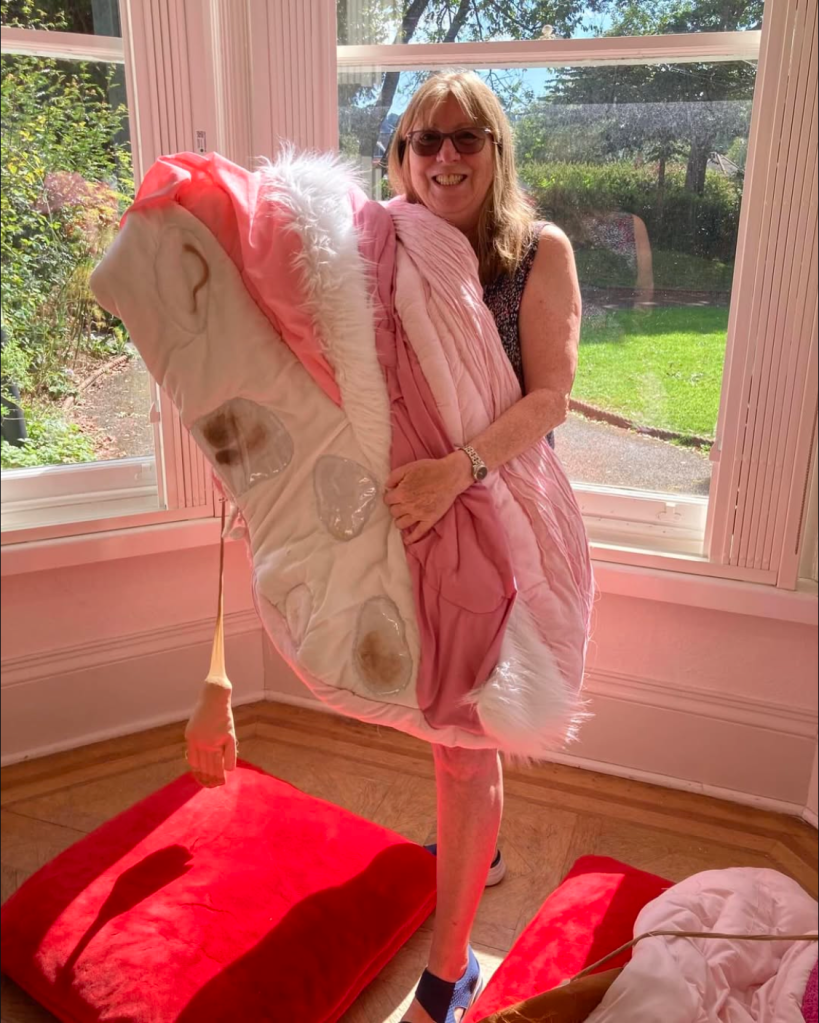
At the Thelma Hulbert Gallery, several artists demonstrated their techniques live, offering visitors a rare behind-the-scenes look at our creative processes. Though each artist worked with different materials, the live demonstrations allowed visitors to experience textile art in a more tactile and immersive way. Watching their curiosity transform into understanding—and even inspiration—was a powerful reminder of why I create.

Picture by @loubakerartist
Picture by @loubakerartist

Picture by @loubakerartist
The thoughtful engagement of visitors reinforced a crucial point: Art comes to life through the experiences and interpretations of those who engage with it. As an artist, I often approach my work from a conceptual and technical standpoint. However, this experience revealed that the audience’s unique interpretations make the work evolve in unexpected ways, enriching it beyond the artist’s initial vision.
Exciting New Horizons Ahead
The two-year, Arts Council-funded tour of A Visible THREAD has officially come to an end, but its impact on my artistic journey is undeniable. This exhibition was a transformative experience that pushed me beyond my comfort zone and encouraged me to approach my art with greater intention and purpose. It taught me to view my work from new perspectives and inspired me to think more deeply about the role of audience engagement.
One of the most valuable lessons I learned was the power of diverse audience interpretations. Seeing how people interacted with my work sparked new ideas for its development. Moving forward, I plan to explore new ways of presenting my woven pieces. This could include rethinking their display, experimenting with larger or more unconventional forms, and exploring how different installation methods can transform the viewer’s experience. Ultimately, I want to create a deeper connection between my work and those who engage with it, allowing movement and energy to be felt not just in the fabric but also through the audience’s interactions with it.
Looking ahead, I aim to go beyond simply visualizing movement. I want to explore how my work can inspire positive social and cultural change. By reflecting on this idea, I hope to create textile pieces that do more than depict movement—they will embody it, representing the shifts and transformations we experience in society and our daily lives.

Sustainability is also an essential part of my future practice. By integrating sustainable materials and practices, I strive to create works that connect personal stories with broader social issues. This approach will allow my art to have a greater impact, encouraging conversations around both individual and collective experiences.
As an individual artist and a member of seam collective, I’m eager to see how our work will continue to evolve. I look forward to the challenges and opportunities ahead, knowing that each step of this journey will lead to deeper expressions and greater meaning in my practice. My ultimate goal is for my art to contribute to a larger cultural conversation, expanding the boundaries of what art can achieve.
I am excited to continue contributing to the ever-evolving tapestry of creativity and to see where this path leads me. The next chapter is just beginning, and I look forward to sharing it with you.
Stay tuned—this is only the beginning.
Glory
Select references
Bridget Riley Services Limited. (n.d.). Bridget Riley | Homepage. http://bridgetrileyservices.com/ (Accessed: 18 December 2024)
Cumming, R., and Bennett, N. (1984). Working with colour; recent paintings and studies by Bridget Riley, Arts Council of Great Britain
Jackson Pollock. (n.d.). Jackson Pollock. https://www.jackson-pollock.org/ (Accessed: 18 December 2024)
Tate. (n.d.). Bridget Riley | Tate Britain. https://www.tate.org.uk/whats-on/tate-britain/bridget-riley (Accessed: 18 December 2024)
 seam
seam 