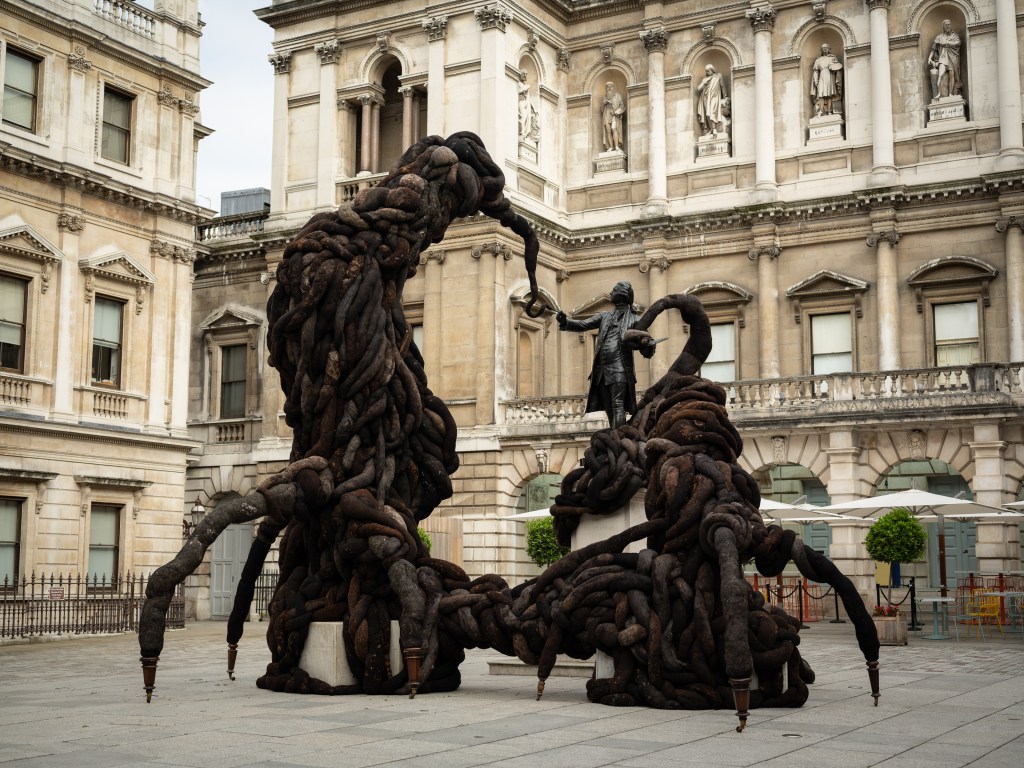
photo: Maxwell Attenborough
In my practice, I investigate the dissolution of boundaries, liminal states, and continuous exchanges across ecosystems. In doing so, I explore the interconnection of life and death, human and non-human, attraction and repulsion. I combine found objects that hold traces of memory, with the shapes of living forms, and materials from organic ‘dead’ matter such as horsehair – a material used previously for bedding and furniture and, in that regard, alive with history and memory. I explore how these materials give off energy forces, including how “dead” matter can provoke a visceral aversion and attraction, that can provoke new ways of looking.
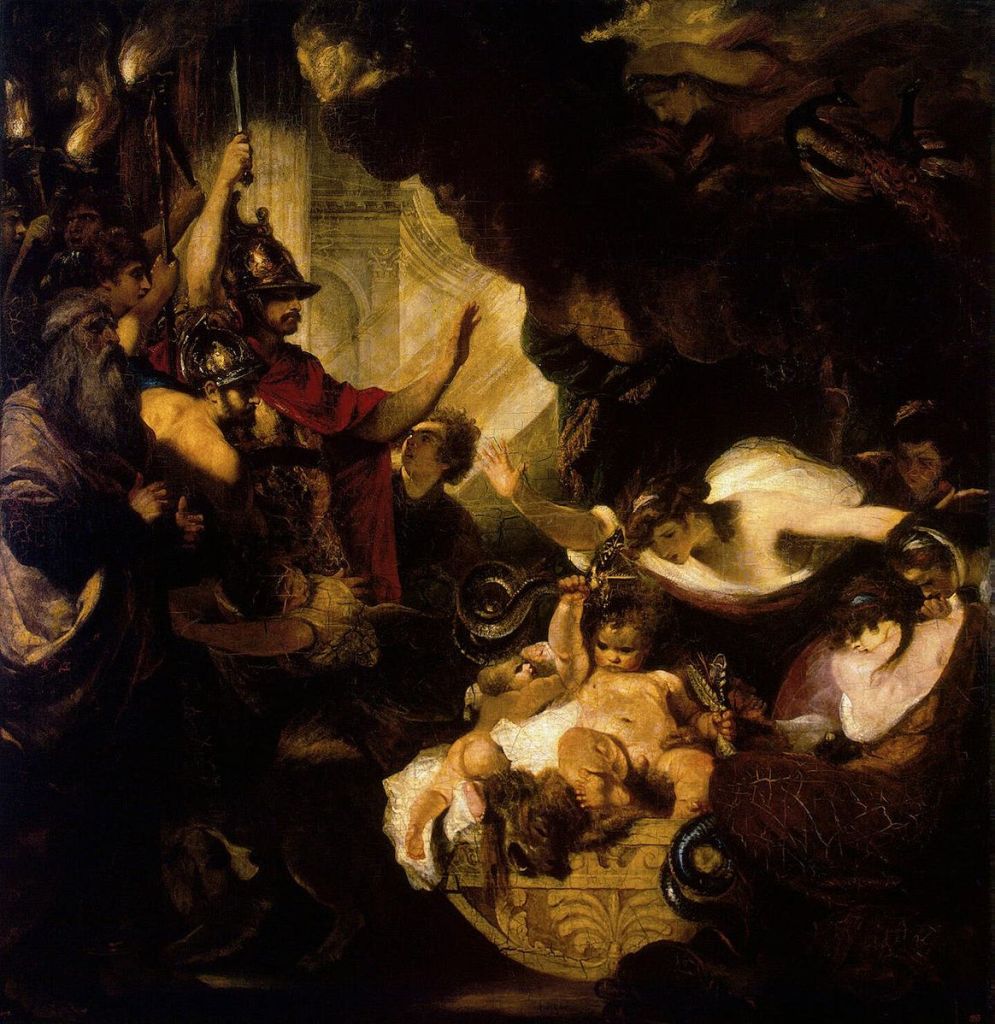
A recent commission I received was from the Royal Academy. I was invited by Ann Christopher, coordinator of this year’s Summer Exhibition, to respond to the statue of Sir Joshua Reynolds in the Annenberg Courtyard and to create a monumental textile sculpture. I was interested in how Sir Joshua Reynolds looked both backwards and forwards, borrowing compositions, poses and subjects from earlier works while establishing new work. Layers of memories are present in his paintings. Two works of Reynolds that have caught my attention are both late paintings; The Infant Hercules Strangling Serpents in his Cradle painted in 1788 and The Death of Cardinal Beaufort painted in 1789.
Public domain, via Wikimedia Commons
The Infant Hercules Strangling Serpents in his Cradle was a subject chosen by Reynolds himself, as a commission for Catherine the Great, whose only stipulation was for it to be a history painting. Apparently, Reynolds spent more time working on it than on any other work he created. He was frustrated he was not recognised as a history painter so this must have been a welcome commission. The painting is based on a version of the story by the Greek poet Pindar (translation made by the 17th century English poet Abraham Cowley, whom Reynolds admired). Reynolds depicts Hercules, Zeus’s illegitimate child, as a baby fighting off the two snakes sent by Hera, Zeus’s wife. The dark mass extending from the drawn sword combines clouds, fur, feathers, skin and folding fabric that encircles Hercules. There is a powerful, engulfing, volatile, circular motion of mass that I drew on for my site response.

The Death of Cardinal Beaufort was commissioned for Boydell’s Shakespeare Gallery in 1789. The scene is taken from the second part of Shakespeare’s Henry VI, Act III, Scene iii. The death throes of Cardinal Beaufort, who was the Bishop of Winchester and the King’s great uncle, are witnessed by Henry VI, Warwick and Salisbury.
King Henry laments:
“Look with a gentle eye upon this wretch;
O! beat away the busy meddling fiend
That lays strong siege unto this wretch’s soul
And from his bosom purge this black despair.”
Now at Petworth House, the painting has recently undergone conservation by Sophie Reddington and, by removing many layers of varnish, a ‘meddling fiend’ has been revealed in the darkness. I am interested that Reynolds got criticism for painting the fiend in 1798 and that on later copies of the painting it was etched out and forgotten.

photo: Maxwell Attenborough
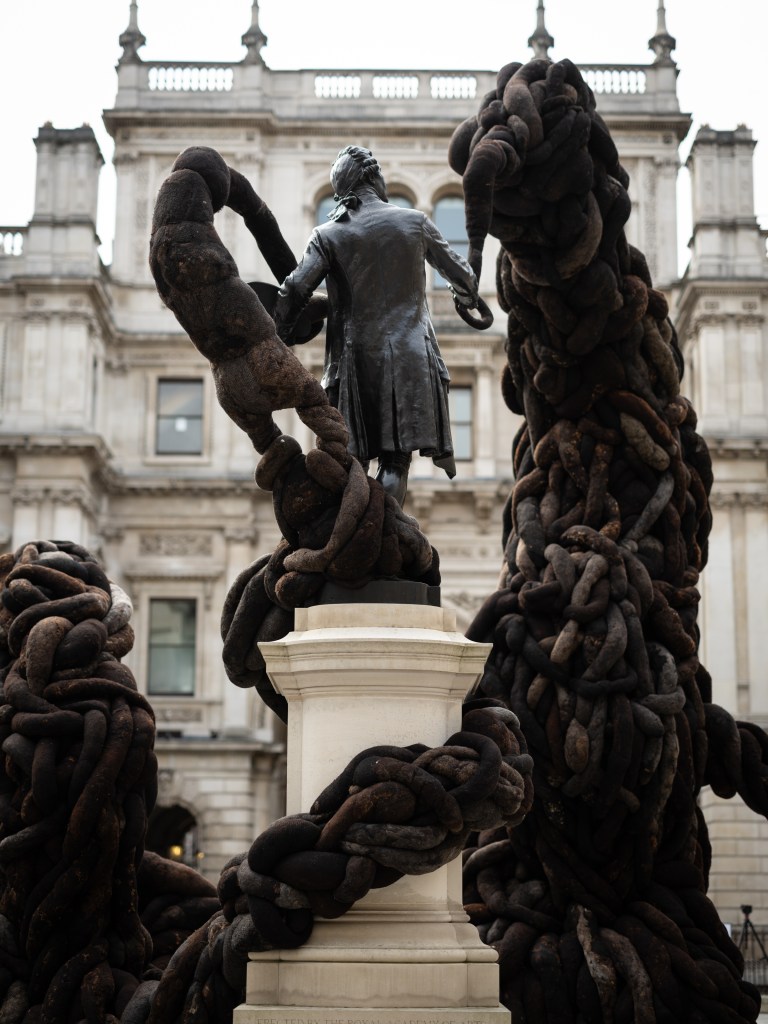
photo: Maxwell Attenborough
In 1782 Reynolds suffered a paralytic stroke, he struggled to hear in later life and in 1783 had a ‘violent inflammation’ in the eyes, finally losing his sight in 1790. In 1792 he died of liver complications. In his lectures on art, delivered at the Royal Academy, Reynolds stressed the arduous, and thus morally uplifting, nature of art. I was inspired by the way Reynolds juxtaposed the darker shades of life with images of birth and renewal. Samuel Taylor Coleridge quoted Sir Joshua Reynolds as declaring that: ‘The greatest man is he who forms the taste of a nation; the next greatest is he who corrupts it.’
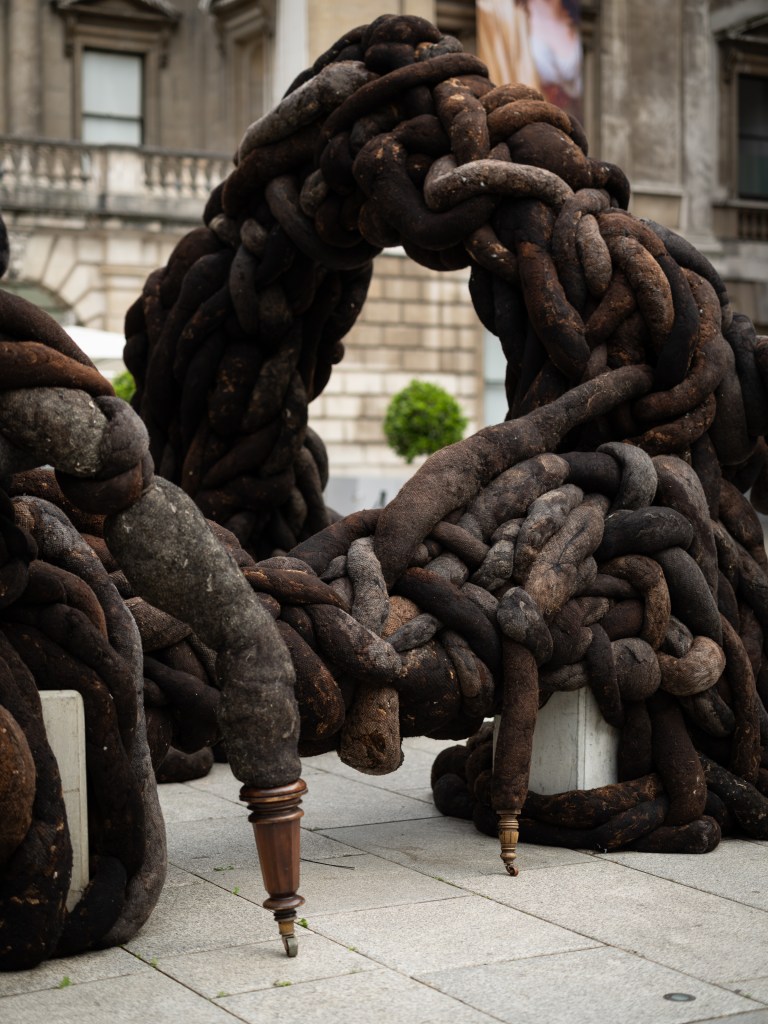
photo: Maxwell Attenborough
In my sculpture, titled The Meddling Fiend, I explore the blurred boundaries between life and death. In this state of confusion and unsettlement an affirmation of life’s forces arises. I drew on these two paintings to create a site responsive installation that created a new space between it and the sculpture of Reynolds. The installation occupies the Annenberg Courtyard for the duration of the Summer Exhibition (18th June – 18th August 2024).

photo: Maxwell Attenborough
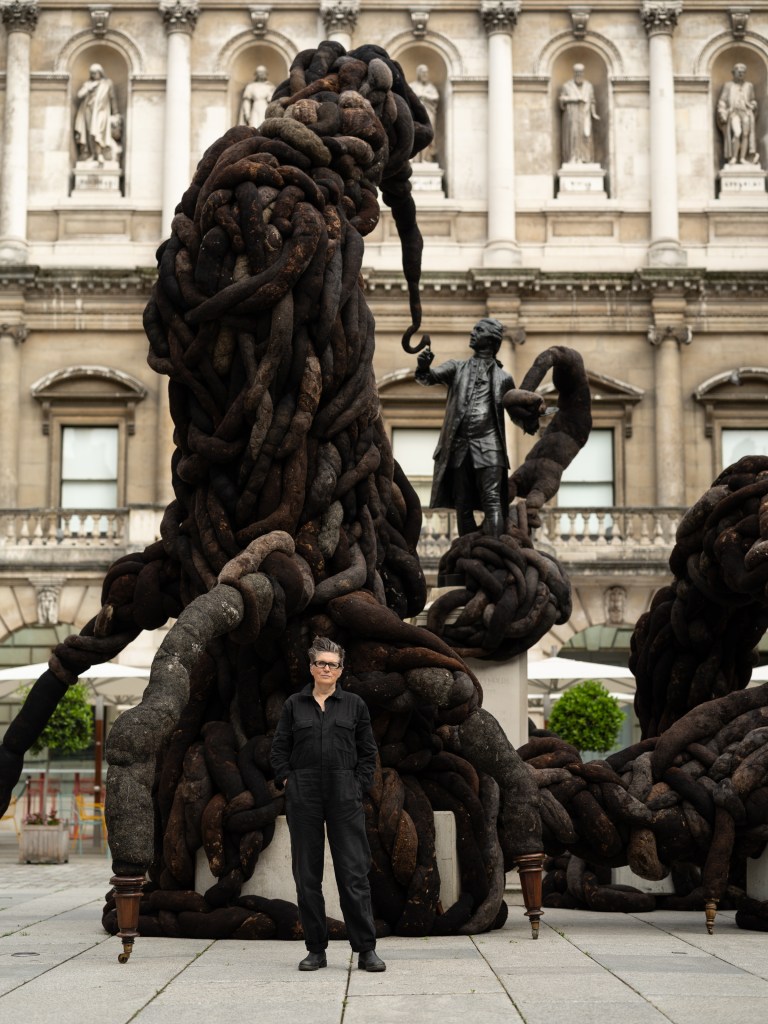
photo: Maxwell Attenborough
For more information about my work visit my website www.nicolaturner.art
The Meddling Fiend is in the public realm. To book tickets for the rest of the Summer Exhibition go to https://www.royalacademy.org.uk/exhibition/summer-exhibition-2024.
Nicola Turner
 seam
seam 