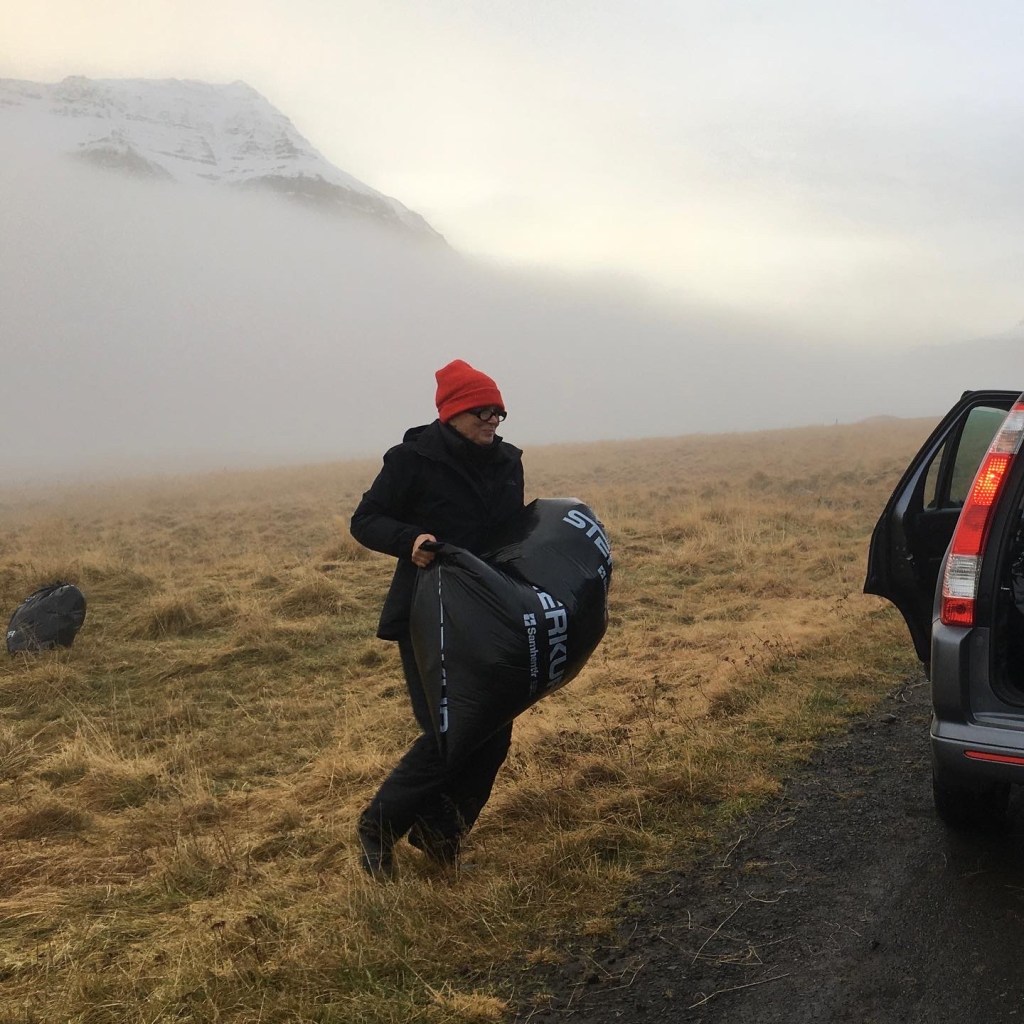
photo: Julia Martin
My first opportunity to exhibit work, as part of the A Visible THREAD exhibition, was at the Black Swan Arts Centre in Frome. I installed a work responding to the fireplace in the gallery which I titled Belshazzar’s Feast after the painting by Rembrandt of the same name.
‘In his great dramatic painting, Rembrandt tells a story from the Old Testament (Daniel 5: 1–5, 25–8). The man in the gold cloak, enormous turban and tiny crown is Belshazzar, King of Babylon. His father had robbed the Temple of Jerusalem of all its sacred vessels. Using these to serve food at a feast, as Belshazzar does here, was seen as sacrilege. In the middle of the party, a clap of thunder came as a warning. God’s hand appeared from a cloud and wrote in Hebrew script: ‘You have been weighed in the balance and found wanting.’ Within hours, Belshazzar was dead.’ (National Gallery, 2016)

photo: artist
I see my work as creating a presence, and possibly an omen. Dark forces can be domesticated and we can follow certainties as adults, to simplify our lives, but those forces can never be completely quashed and indeed can become sources of creativity and life. In my practice, I investigate the dissolution of boundaries, liminal states, and continuous exchanges across ecosystems. I explore the interconnection of life and death, human and non-human, attraction and repulsion. I combine found objects that hold traces of memory, with the shapes of living forms, and materials from organic ‘dead’ matter such as horsehair – a material used previously for bedding and furniture and, in that regard, alive with history and memory. I explore how these materials give off energy forces, including how ‘dead’ matter can provoke a visceral aversion and attraction, that can provoke new ways of looking.
In Belshazzar’s Feast I used a mixture of horsehair, coir, wool and an old chair leg. I transport the material as tendrils encased in net and then twist, tie and stitch them together in situ, responding to the place and architecture.
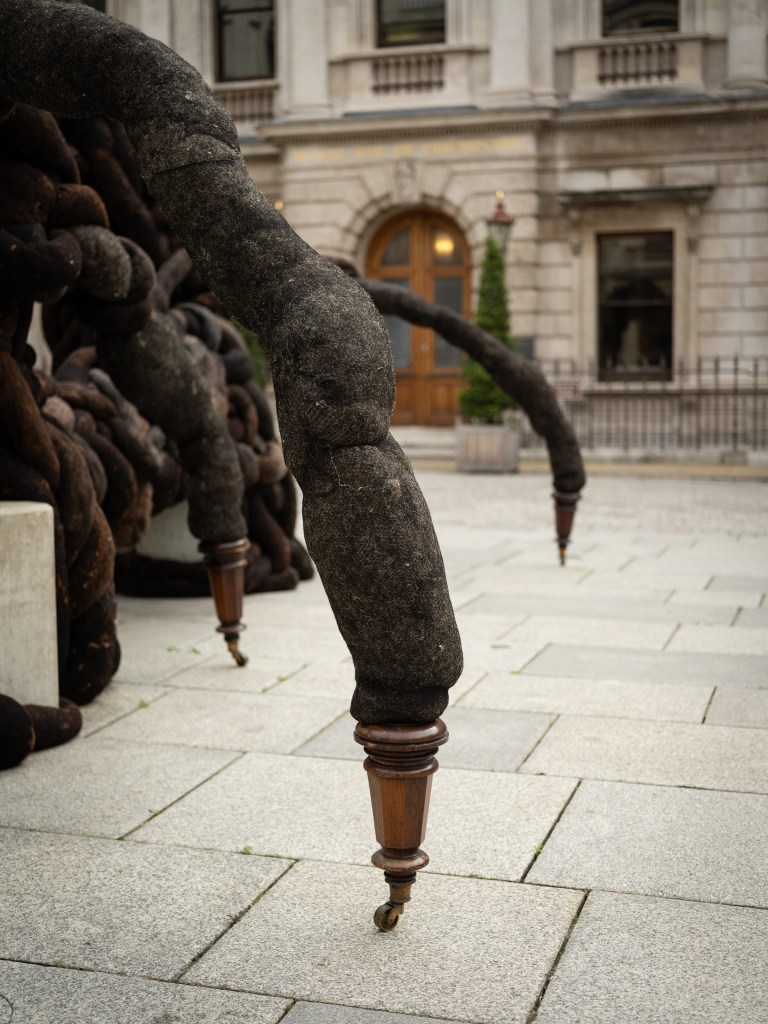
photo: Maxwell Attenborough
In my practice, I am drawn to work with horsehair and wool, ‘dead’ matter, materials which I will explore below, in turn.
Horsehair
My mother worked as an upholsterer so the materials used in traditional upholstery were part of my childhood. I collect horsehair from upholsterers who have stripped it out of old chairs and sofas, and are replacing it with new, so they no longer want the old hair. I search for old horsehair mattresses that are being thrown away. Both these types of horsehair have been processed to hold a curl. The horsehair would have been washed, steamed and rinsed and then spun into a twisted rope to create a curl. It is steamed to keep the curl permanent. The rope is then teased apart which creates lots of small springs that hold their shape when used in upholstery. Horsehair is extremely durable and resilient, returning to its sprung shape after it has been compressed, meaning a mattress can be used for hundreds of years. Horsehair strands are also hollow, allowing free ventilation therefore maintaining a good temperature and preventing mould, fungi and dust mites. Horsehair is a protein fibre and absorbs water very slowly. It is naturally fire repellent.
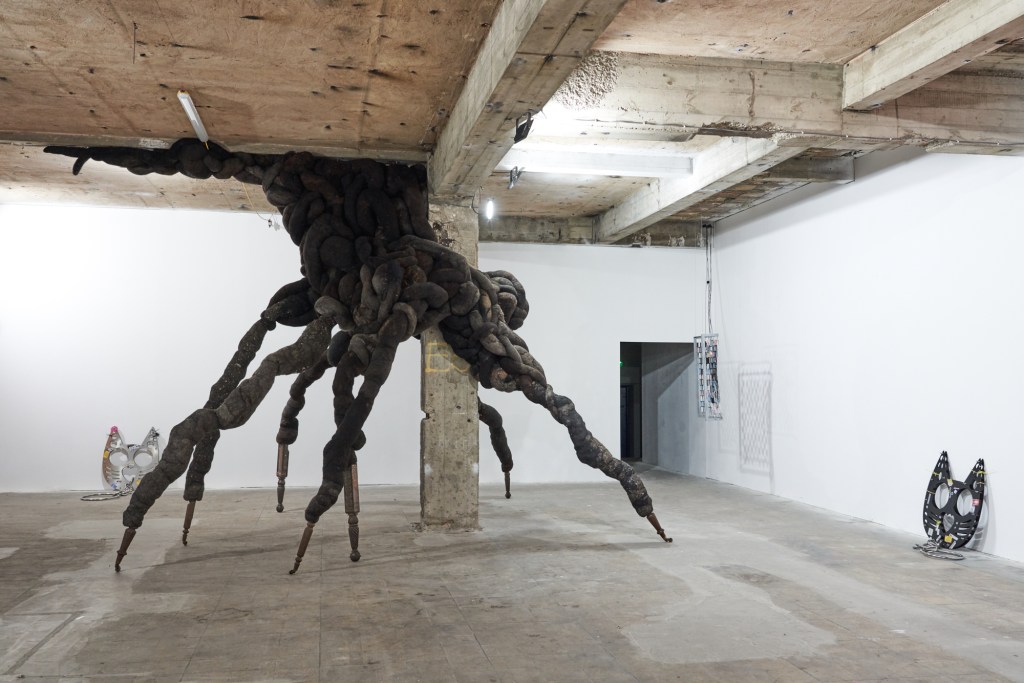
photo: Joanna Wierzbicka
Archaeological evidence (Brittania) suggests that horses were domesticated approximately 6000 years ago around the Black Sea, Ukraine and Kazakhstan. Recent genetic analyses (Librado 2021) suggest there was more than one domestication event and that horses have been widely interbred over the years. In Britain, domesticated horses were in evidence in the Bronze Age, from around 2000 BCE. Horsehair was used in textiles from the 8th Century. Other uses over the years have included paintbrushes, fishing lines, bows for stringed instruments, shaving brushes, hats, jewellery, wigs, in plaster and as thread for sutras. From the Renaissance, horsehair was used as a mattress stuffing and, in the 19th Century, was commonly used in upholstery. Horsehair is mainly sourced as a by-product. Hair is from the mane, the tail and the body hair of some shaggy breeds. It is collected while grooming, or at the end of life. Mongolia produces 40% of the global demand (Dulguun 2019). With a cold climate their horses grow thick hair. I collect waste horsehair. Hair that has been already been used in a domestic setting.

photo: artist
As I sort through the waste hair, I find threads, scraps of fabrics, buttons and items that have been swept into the hair. Horsehair is scratchy and can be dusty, after all we lose 300,000 skin cells every night. That’s 10 grams of dead skin cells a week, some of which ends up within the mattress itself. I have been collecting horsehair mattresses from skips, freecycle, eBay, and other online marketplaces. I’m fascinated by what stories they have absorbed over the years. One mattress given to me was initially on a four-poster bed in Fetteresso Castle, near Stonehaven in Scotland, and in 1715 James Stuart, or rather the ‘Old Pretender’, was unofficially crowned there and proclaimed King James Ill by the Earl of Mar. I was told he probably slept on the very mattress I was given. Today, there are (to my knowledge) only two factories making horsehair fabric: John Boyd Textiles in Somerset and Manufacture Française du Crin, in France.

photo: artist
I believe humans hold important connections to materials. This idea is explored by Jane Bennett in Vibrant Matter. Bennett theorizes that a ‘vital materiality’ runs through and across bodies, both human and nonhuman (Bennett 2010). As I work with horsehair, its history becomes part of me (quite literally, when I breathe in or swallow dust) and I become a part of its history, as I mould it into new forms and new appreciations. I collect the dust in jars, not wanting to throw embedded history away. The verb ‘embed’ comes from “to lay in a bed (of surrounding matter)”, from em- + bed (n.) originally a geological term in reference to fossils in rock. I collaborate with the artist Clare Whistler as TURNER+WHISTLER to explore these interconnections further through movement and sound.
Responses to hair from the body and dead skin cells can be abject. It repels but also seduces the viewer. Slavoj Zizek writes ‘Abject points to a domain which is the source of our life intensity – we draw our energy out of it, but we have to keep it at the right distance. If we exclude it, we lose our vitality, but if we get too close to it, we are swallowed by the self-destructive vortex of madness’ (Žižek 2019). I hope my sculptures allow an exploration of what is this ‘right’ distance, for each viewer.
Wool
A person I bought some upholstery materials from described my work as: ‘the soft, cosy blanket of loneliness that I sometimes choose to wrap around me (in my head [it] smell[s] reassuringly of sheep wool)’. This coincided with Nick Parker, of Stone Lane Gardens, sending me a link to someone selling off Zwartble Fleece on Facebook marketplace. I soon had fleeces piled up in my studio and immediately was enraptured by the material and started using wool in my work (this was in 2021).

photo: artist
My studio at that time was in Slaughterford Mill and while there, I found out that my great-great-great-great-great-grandfather Peter Drewett Jr, Clothier of Colerne and Batheastern, was running the Mill, ‘fulling’ wool (processing wool into broadcloth by pounding and felting it), up until 1785. There I was, knee deep in wool, in the same location my ancestors were processing wool over 200 years before. It is interesting what drew me to work in that location. Wool is currently an undervalued material. While on a residency at Skaftfell Art Center in Seyðisfjörður, Iceland I stumbled across a pyre of wool, that I rescued before it went up in flames, to use for my site responsive installations.

photo: artist
Sheep were domesticated by humans over 9000 years ago initially for their meat and milk. About 6000 years ago wool started to be used as a textile. In Eastern Iran spindle whorls and scraps of textile were discovered from 5000 years ago. Early sheep would have been similar to the European Mouflon, Soay, Hebridean and Icelandic sheep we see today, slowly being bred for better fleece (Coulthard 2020).
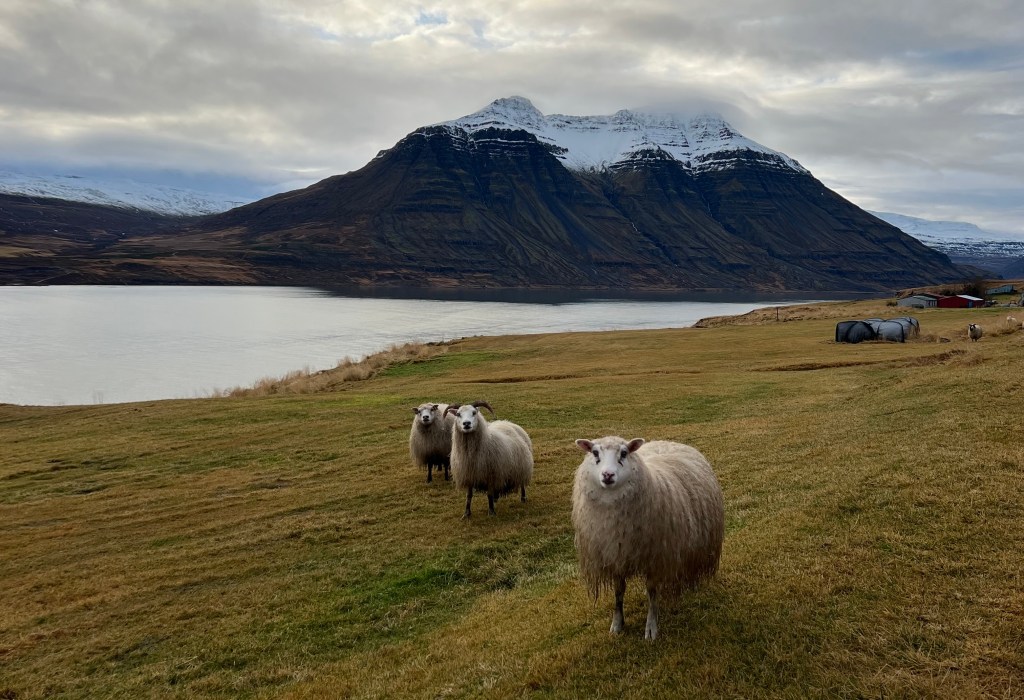
photo: artist
Early sheep would have naturally shed their fleece but then evidence suggests rooing (plucking), tearing, combing and cutting with a stone scrapper took place. Metal shears were first recorded in a neo-Babylonian text in 500BC and the design is very similar to hand shears still in use today. I use three such shears in my sculpture Klipp und Klapp. Since the bronze age, sheep similar to the Soay breed were in Britain but it wasn’t until the Romans arrived, bringing new breeds, in 43AD, that a well-organized wool trade developed. By the medieval period wool was the major export and at its height, out of a population of 6 million in the UK, a quarter of the whole population were involved in the wool trade (Coulthard 2020).

photo: artist
Wool, like horsehair, is a protein fibre. It is scaly in texture so has the benefits of being a great insulator. Naturally fire resistant due to its high nitrogen and water content. It is naturally elastic and can stretch and then return to shape. It can absorb 40% of its own weight in moisture before feeling wet. It is robust and hard to break. Wool can be scoured, fulled, spun, woven, felted and knitted. I work with raw wool. When I am working with raw wool, the lanolin comes off on my hands and makes them extremely soft. In fact, lanolin was an early ingredient of cosmetics and used to treat skin conditions. I am interested in the connection we have to wool as a material. How the smell, especially of wet wool, provokes a visceral response. I love the smell but some others are repelled by it. What is it in our lived histories that evokes such different responses?
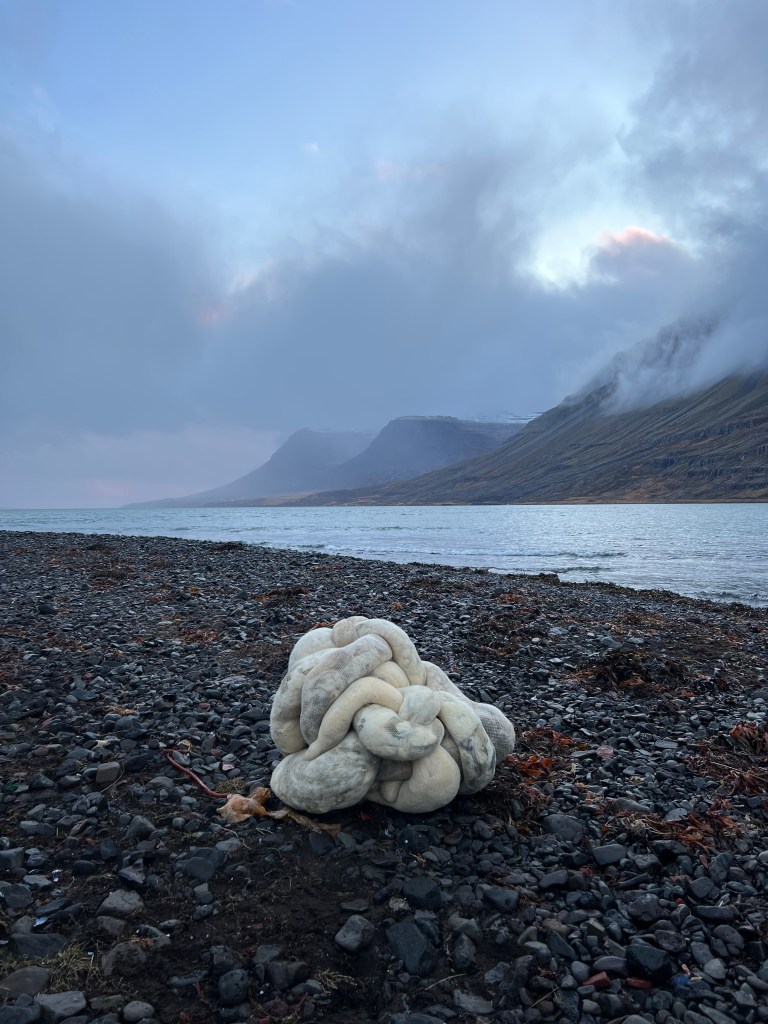
photo: artist
Conclusion
In my practice I investigate my connection to material, to ‘dead’ matter. I am interested in the traces we leave in objects we touch, how objects evoke memories and how we are interconnected to the environment around us. My sculptures are part of a vital and thriving microcosmos comprised of human and non-human agents which functions mostly beyond our conscious contemplation.

photo: artist
‘There is no empty space, everything is inhabited, each one of us is the gathering and crossing point of quantities of affects, lineages, histories, and significations, of material flows that exceed us. The world doesn’t environ us, it passes through us. What we inhabit inhabits us. What surrounds us constitutes us. We don’t belong to ourselves. We are always-already spread through whatever we attach ourselves to.’ (Comité Invisible 2015)

photo: Katy Docking, Od Arts Festival 2023 www.odartsfestival.co.uk
I find resonance with Donna Harraway’s theories on tentacular thinking (Harraway 2015). The tendrils I create (from wool and horsehair in nets) can sometimes seem alive, like tentacles. Harraway plays with the way that tentacles are ‘feelers’ both sensing the world and affecting the world. Tentacles offer a metaphor for how we are enmeshed in the living world – affected and affecting – entangled through our gut, how we perceive, how we feel, how we think. The exhibition A Visible THREAD gave me the opportunity to connect my material with the layers of history found in the Black Swan Arts Centre in Frome.
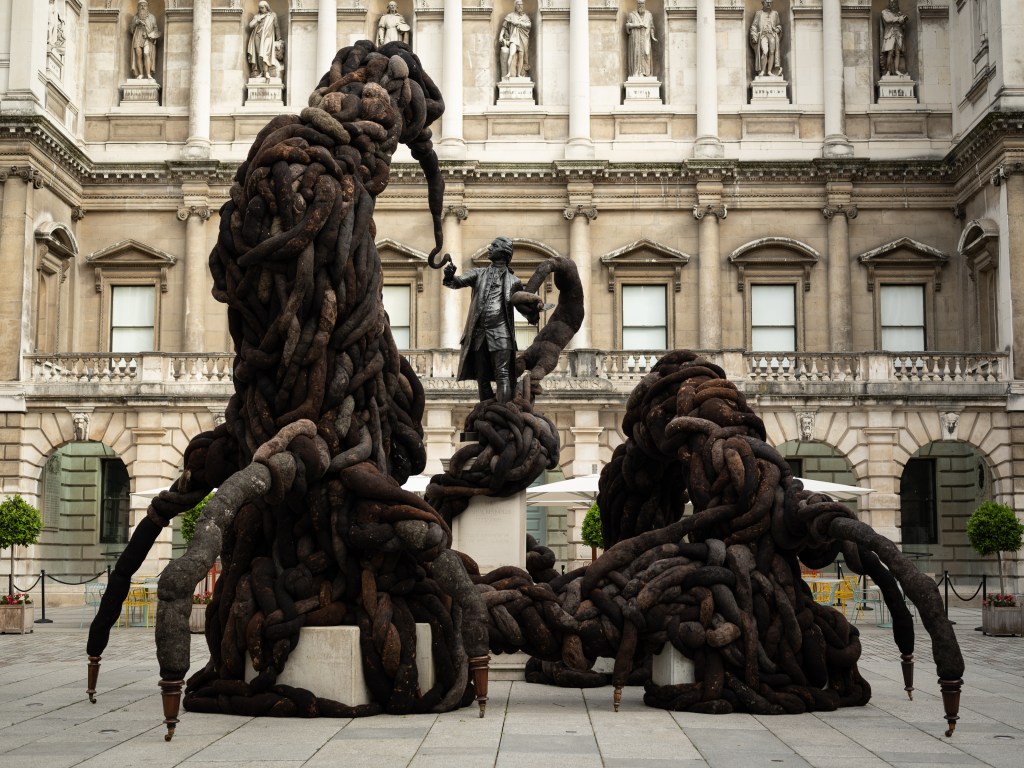
photo: Maxwell Attenborough
My work can currently be seen at the Royal Academy Summer Exhibition, until the 18th August, London. Two exhibitions will open in September; Spinning A Yarn in Glastonbury with Somerset Art Works and The Uninvited Guest from the Unremembered Past at Tyntesfield with the National Trust. For more information about my work visit www.nicolaturner.art.
Nicola Turner
References
Bennett, J. (2010) Vibrant Matter: a political ecology of things: Durham, Duke University Press
Britannica, T. Editors of Encyclopaedia (2021) horse summary. Encyclopedia Britannica. https://www.britannica.com/summary/horse (Accessed 3rd July 2024)
Comité Invisible. (2015) To Our Friends (R. Hurley, trans): Semiotext(e) Intervention Series
Coulthard, S. (2020). A Short History of the World According to Sheep. United Kingdom: Head of Zeus.
Dulguun, B (2019) https://www.theubposts.com/a/11669 (Accessed 3rd July 2024)
Haraway, D. (2015) Anthropocene, Capitalocene, Chthulhucene. Donna Haraway in conversation with Martha Kenney. Art in the Anthropocene, Encounters among aesthetics, politics, environments and epistemologies, pp.255-270. Open Humanities Press
Ingold, T. (2007) Materials against materiality, Archaeological Dialogues, 14(1), pp. 1–16. doi:10.1017/S1380203807002127. Cambridge University Press
Librado, P., Khan, N., Fages, A. et al. The origins and spread of domestic horses from the Western Eurasian steppes. Nature 598, 634–640 (2021). https://doi.org/10.1038/s41586-021-04018-9
National Gallery. (2016) Belshazzar’s Feast [Photograph]. Available at: https://www.nationalgallery.org.uk/paintings/rembrandt-belshazzar-s-feast (Accessed: 3 July 2024).
Žižek, S. (2019) Disparities: Bloomsbury: London, p.170
 seam
seam 