Why on earth would a weaver choose to emulate designs from the 19th century for a contemporary textile art exhibition? And what does this have to do with making thread visible?
After researching the harsh living conditions of Norwegian farming and weaving communities through the centuries, I felt compelled to celebrate the valuable lessons the weavers of the past have taught me in my own weaving. Lessons about material intelligence and sustainability, and the way these themes connect to my textile practice.
Thread as thought
Material intelligence is at the heart of Glenn Adamson’s book Fewer, Better Things. The Hidden Wisdom of Objects. In this book, he introduces the idea that a deeper understanding of the physical objects in our lives will provide stronger connections to the materials used to create them, and to the people involved in that process. This will in turn encourage us to become more informed to make better choices as consumers.
In the work I created for the A Visible THREAD exhibition, I wanted to connect the patterns and colours of the past to the present, in a physical, functional object; a handwoven Krokbragd rug.
This functionality is significant and I’m comfortable that the rug falls into the categories of textile art and craft. It has a story to tell, and part of that story is its usefulness.

Thread as a connection
I want the rug to act as, in the words of Adamson, ‘a point of contact between people‘.
A connection to the thousands of years of weaving history that has come before me, and more recently, a connection to my tutor, the late Susan Foster, who taught me the technique, just as the weavers in Norway passed on their knowledge to the next generation during the long cold winters.
If we go back in time to the origins of Krokbragd, the particular weaving technique used in the work, we will find ourselves in a soot-filled Norwegian farmhouse in the 1800s.
In beautifully illustrated chapters of Katherine Larson’s Book The Woven Coverlets of Norway, we see the lives of families dictated by the seasons. Summer for farming, sheep shearing, growing crops and plants for dyes, and preparing for the long hard winter. And then winter, when carding, spinning and weaving would fill the cold, dark days and the cloth for clothes, sails, bedding, and finally decorative homewares would be woven. Skills were passed down from generation to generation, and each farm has its own distinctive style. A few examples of these motifs are featured in my woven textiles.
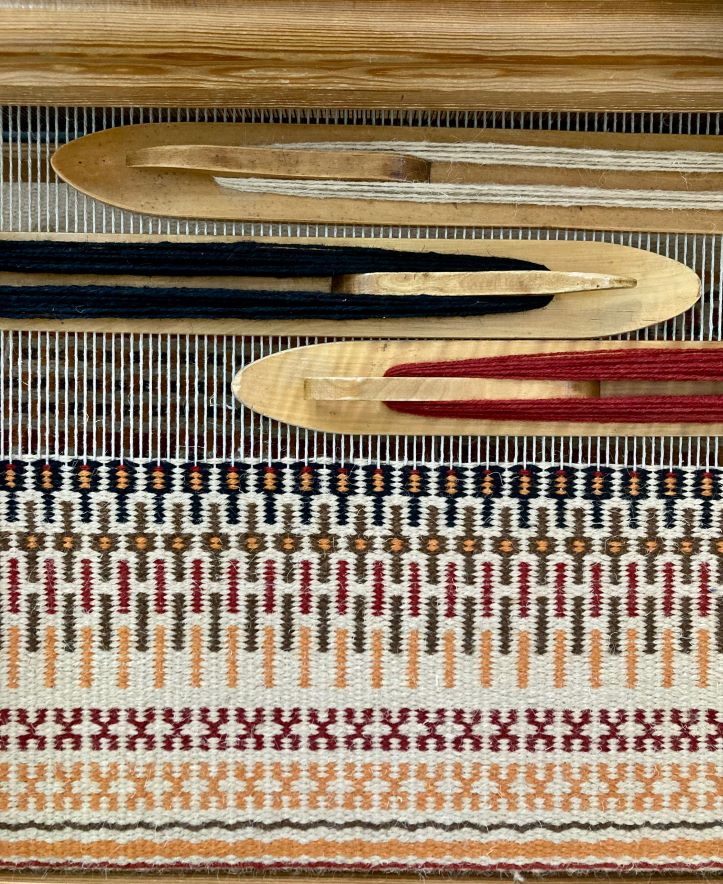
I usually use linear patterns and an abundance of readily available brighter hues, but I’ve used a restricted palette in one of the pieces. The Norweigan weavers would have predominantly used the undyed sheep’s wool with naturally dyed brighter shades used sparingly.
This contrasts with the rugs I usually weave. For thirty years I’ve used contemporary colours and less detailed pattern blocks to ensure my Krokbragd rugs do not look like the Krokbragd coverlets found in the farmhouses. It was refreshing to weave one that did!
In my samples, I’ve woven the story of the threads from this time to the present day. Hot pinks, synthetic neon yarns and glitter contrast with the brown and white wools found in the original bed coverlets.

Thread and well being
It’s not hard to understand the value of every item in these sparse farm dwellings. While we wouldn’t want to return to these living conditions, today’s advances in technology and time-saving devices appear to have brought society as many problems as they have solved.
Many people are now returning to making things as a hobby, as a way of slowing down and balancing their constant busyness of work and life.
The benefits of making and the positive impact on the well-being of the maker are well documented, and from personal experience, I can say that time spent at the loom is the best part of my job, even when deadlines are looming. Creating work that I find aesthetically pleasing gives me satisfaction and direction, and balances the pressures of earning a living from weaving textiles in the 21st century.
My intention for A Visible THREAD is to present a well-made textile artwork that catches the eye and starts a conversation about how and why it has been made. In turn, to leave the viewer which a new appreciation for an object they might ordinarily walk over without a second thought.
‘The key thing is to cultivate curiosity about the material world: to get in the habit of wondering how things were made, and by whom. This can help, in turn, to develop a healthy appreciation for just how much human ingenuity can be embedded within even an apparently simple thing.’
Glenn Adamson. The Case for Material Intelligence. Originally published in Aeon Magazine, November 2018
Thread and sustainability
The materials used to create the rugs and woven artworks reinforce the connections to what has come before; as well as being second-hand and therefore meeting my sustainability targets.
The yarns are mainly from the workshop of the late Peter Collingwood (OBE) and his son Jason Collingwood, both prominent British rug weavers. I now have at my disposal an abundance of rug wool and linen amassed over decades. The opportunity to have the option of never needing to buy new materials at a time when every business is taking a hard look at its supply chain was too good to turn down. Like a character in a Brothers Grimm Fairy Tale I might now have more wool than I can weave in a lifetime…and no sign of Rumpelstiltskin. You can read more about this here.

never buy new materials again
Turing the woven samples for the rugs in the exhibition into miniature sculptural artworks is another way that I’m ensuring that every thread is used and nothing is wasted. The batons represent the journey of the Krokbragd coverlets of the past and their influence on the colourful woven rugs which are more closely associated with my practice today.
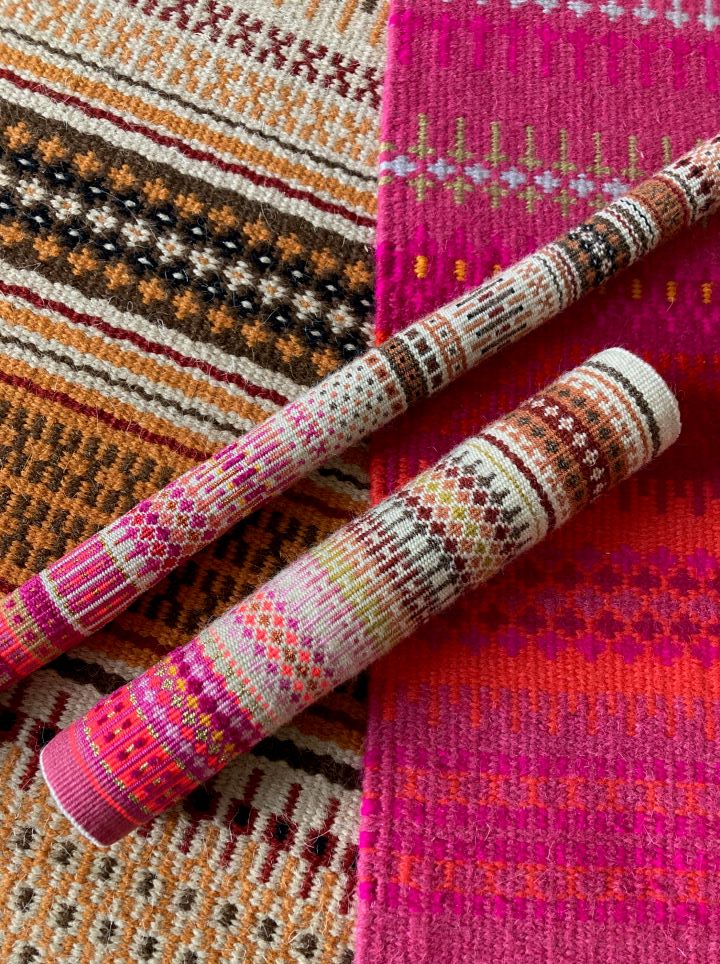
Reducing waste in my practice.
Do come and see the rugs during our A Visible THREAD tour, at:
- Fine Foundation Gallery, Swanage: 16 May – 7 June 2023
- Black Swan Arts, Frome: 16 September – 29 October 2023
- Llantarnam Grange, Cwmbran: 17 February – 4 May 2024
- Thelma Hulbert, Honiton: 20 July – 31 August 2024
See seam collective’s website and Instagram for full details of the tour, workshops and participatory events and sign up for seam’s newsletter for regular news and updates.
Angie Parker
SELECT REFERENCES:
Adamson, Glenn, 2018, Fewer, Better Things. The Hidden Wisdom of Objects, Bloomsbury.
Adamson, Glenn, November 2018, The Case for Material Intelligence. Originally published in Aeon Magazine
Crafts Council (2020) 4 reasons craft is good for your mental health. Available at: https://www.craftscouncil.org.uk/stories/4-reasons-craft-good-your-mental-health
Larson, Katherine, 2001, The Woven Coverlets of Norway, University of Washington Press
 seam
seam 